Warning: Undefined array key "mode" in /home/jworldti/public_html/wp-content/plugins/sitespeaker-widget/sitespeaker.php on line 13
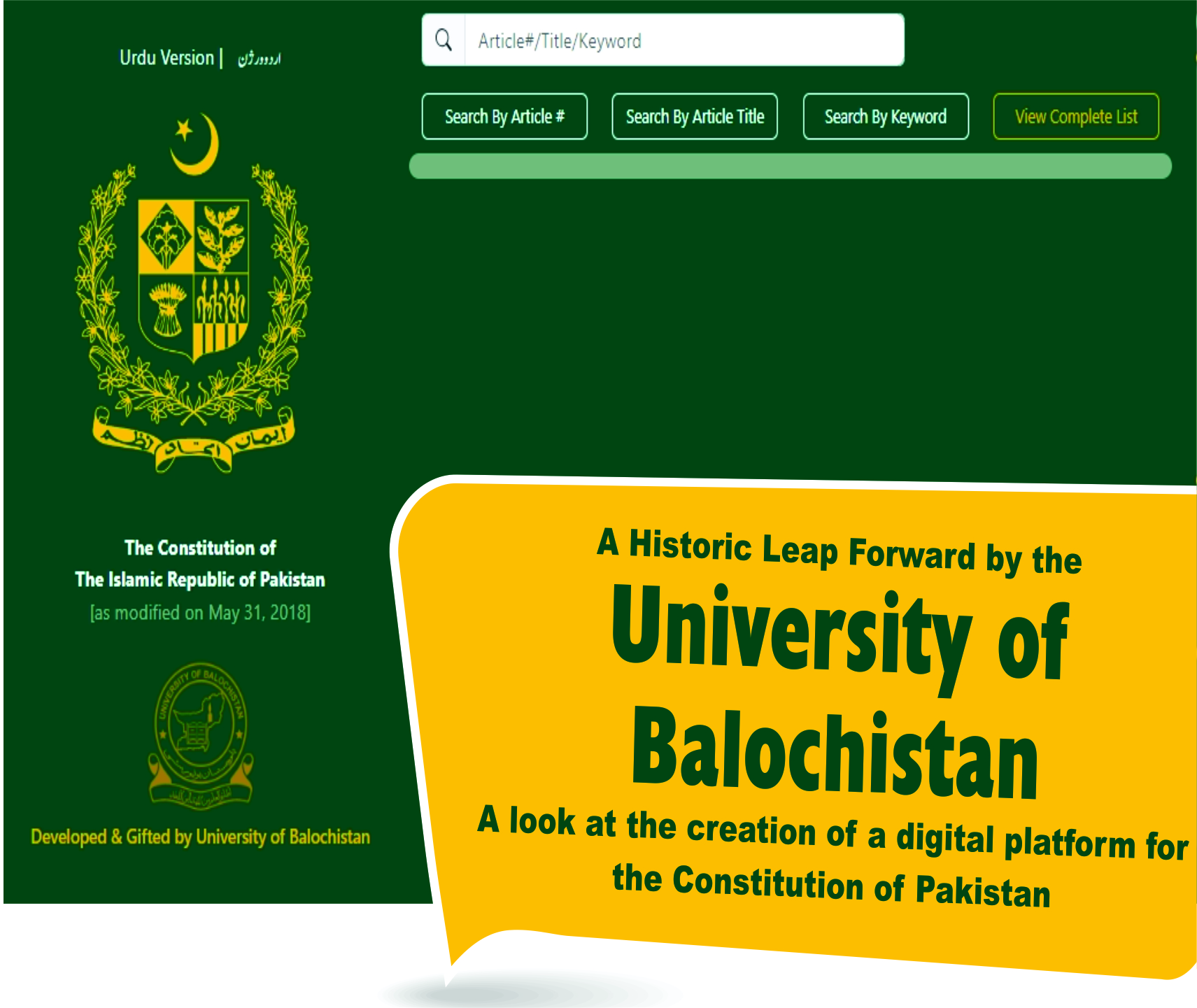
A Historic Leap Forward by the
University of Balochistan
A look at the creation of a digital platform for
the Constitution of Pakistan
Ghulam Mohyuddin
It is often said that one of the greatest intellectual pursuits of humans is the ‘making of a constitution’. And, there is no denying that people all over the world resort to a written constitution for guidance when it comes to their daily affairs related to activities like policymaking, business, manufacturing, tourism, aviation, science, engineering, healthcare, education, media, communications and many other fields.
Fundamentally, a constitution is a document that provides for the framework for governance. It also defines the rights and responsibilities of citizens and outlines the structure of the country’s political system. A constitution acts as the supreme law for a particular geographical unit and serves as the foundation on which the legal and political edifice of a nation rests.
Structured on a positive intellectual base and aiming to achieve the coveted goal of public welfare, a written constitution vividly defines the scope and powers of, and distribution of authority between and among, all branches of government while also providing for checks to prevent any abuse of power. This division of powers ensures a robust system of checks and balances that acts as a bulwark against domination by any one branch of government.
The Constitution provides the basis for democratic governance by helping build a fair and transparent political system. It also serves as a legal framework for the resolution of disputes as well as for the interpretation of law.
Courts also rely on the principles laid down in the Constitution to decide cases brought before them. In fine, a written constitution is the principal means for establishing a fair, accountable and stable governance system that not only prevents the misuse or abuse of powers but also safeguards the rights and liberties of citizens.
This lengthy description is, in fact, related to the understanding of, and abiding by, the Constitution in the current state of affairs in our country. It is because, for the past few years, there has been recurrent confusion with regard to the interpretation and implementation of various articles of the constitution.
Hardly a constitutional debate settles that a new one rears its head. In this murky nature of things, one often hears, on various forums, the references to such articles of the Constitution of Pakistan that, if studied, either do not contain anything being claimed or have no relevance with the context in which they are being quoted. People are not told about the real nature of the said article(s). One principal reason behind this state of affairs is, indubitably, a skewed understanding of the constitution in our country. A vast majority of Pakistan’s population is nescient of the real text of the constitution and they pass hearsay on to others without investigating its veracity.
A limited understanding of the constitution in our country is also because people do not have easy access to the sacred document we call the constitution of Pakistan. Although it is available in book form in various libraries or even at bookstores, finding an Urdu version of this sacred document is an uphill task. And, the non-availability of it in Urdu text is a major reason why we have a limited understanding of the Constitution.
In this age of information technology, a solution to this enigma could be ensuring the online availability of Urdu text. And, we have, though, made headways in this regard as the English and Urdu versions of the Constitution of the Islamic Republic of Pakistan are currently available on the website of the National Assembly in Portable Document Format (PDF) and the National Database & Registration Authority (NADRA) has also recently created an application (app) for that wherein the English version of the Constitution is searchable to some extent but the Urdu version has been taken from the National Assembly in PDF. So, there was no dedicated web-based platform for people to go through the Constitution.
And, this is despite the fact that we are living in an era characterized by rapid technological advancements and digital transformation where Pakistan, unfortunately, finds itself at a crucial crossroads. In this state of affairs, there was a pressing need to make available for the people of Pakistan a digital version of the constitution. Analysts and experts also assert that in order to keep pace with the global digital revolution, we need to create a comprehensive digital edition of the constitution to ensure accessibility, transparency and efficiency in governance. The move to ensure the digital availability of the constitution is advocated for as a progressive step towards a brighter future.
The Constitution of Pakistan, which was adopted in 1973, has served as the foundation of the country’s legal framework for nearly five decades now. However, with the advent of digital technologies, the drawbacks of relying solely on paper-based constitutions have become apparent. Proponents of the digital version cite several reasons for its implementation.
A web-based constitution, also known as a digital constitution or e-constitution, is available and accessible through an online platform or website. Digitizing the Constitution makes it accessible to a wider public, including citizens, legal professionals, researchers, students, overseas Pakistanis and persons with disabilities. Anyone having an internet connection can easily access the Constitution anytime, from anywhere eliminating geographical barriers. It is readily accessible to those interested in studying the country’s legal framework.
Digital access allows users to easily search and find the sections of the Constitution with great ease. This facility is especially highly valuable for members of the legislators, legal experts, researchers, journalists, anchorpersons and students who frequently refer to the text. In addition, a digital version facilitates search through keywords, making it faster to find specific articles, provisions, or keywords within the Constitution. This significantly increases the efficiency of legal research. Digitization allows for the preservation of the Constitution and the comparison of its different versions over time. This can help in tracking amendments to the Constitution, understanding historical changes and analyzing the evolution of legal principles. Digitally accessible documents reduce the need for physical printing and distribution, thereby saving costs and reducing environmental impact as well.
Making the constitution digitally available increases transparency in governance as citizens can access and review the country’s fundamental laws anytime, thereby allowing for greater accountability. When any amendment is made to the constitution, its digital version is updated more quickly and efficiently than that in the printed form. Digitization also facilitates the sharing of the Constitution with international institutions, researchers, and organizations interested in legal and constitutional matters.
Also, digital copies can be preserved and secured easily as their backups are created which mitigates the risk of loss or damage. Moreover, multiple copies of the constitution can be uploaded on different platforms to ensure protection. The web-based format ensures that the Constitution is available around the clock. Gone are the days when constitutions were available only in the form of voluminous books; with the introduction of a web-based platform, the Constitution will be in the pocket of every Pakistani citizen connected to the Internet.
This is indeed an innovation that can bridge the distance between the legal texts and the people. It also transforms a traditionally complex document into an accessible and user-friendly digital resource. People can access it whenever they need it, thereby freeing them from the constraints of office hours or going to a specific location to get the required information. The digital format allows for easy translation of the Constitution into multiple languages, making it more accessible to the diverse linguistic communities in Pakistan.
Moreover, creating and maintaining a web-based platform often involves much lower investment than that required to create physical copies of the constitution, and it is much safer in the long run. Several countries have already successfully embraced the idea of an online constitution.
The Constitution of Pakistan is an invaluable asset of the nation as well as the lifeblood of the country’s democratic system. So, it becomes all the more necessary to make this document easily available to the people so as to promote its understanding among the masses and for its accurate referencing and interpretation at the time of need. This warranted the availability and preservation of the Constitution in digital form.
Moreover, enhancing easy access of the people to the Constitution has become more than a need in this era of information technology. In this context, the University of Balochistan – the oldest educational institution of higher learning in the province entrusted with the responsibilities to educate and train the potentially talented human resource and manpower to meet the emerging needs of the industry and society – has made a historical leap forward by launching Pakistan’s first web-based platform in the form of a dedicated website which offers easy access to both English and Urdu versions of the constitution to facilitate the extraction of the required information instantly.
The idea of launching such a unique platform is the brainchild of Mr Muhammad Atif, who currently serves as program manager with Radio Pakistan. He painstakingly compiled the text of the Constitution of Pakistan into individual articles (both Urdu and English versions) for this website. Besides, he also included the preamble, the annexure and the schedules of the constitution in his wide scope of efforts. Throwing light on his journey, Mr Muhammad Atif said, “When the text of the constitution, especially the Urdu text, was obtained in PDF for the preparation of radio programs in connection with the 50th-anniversary celebrations of the Constitution of Pakistan, I realized that the search of various topics in the Urdu draft of the Constitution was not easy. Whenever I needed a reference, I found it quite hard to find the relevant article and get the textual details. Moreover, the digital presentation of the document of the Constitution didn’t befit its glory and significance. These factors inspired me to create such a digital platform where we could provide search information in the respective languages according to the requirements of the Urdu and English texts of the Constitution. And present the constitution of the country in a dignified manner. Those learned people who transformed this great idea into a tangible reality are the experts from the great alma mater to many, the University of Balochistan (UoB). These men of great skills developed this digital platform within a short period of just 15 days. The text of the Constitution of Pakistan available on this digital platform has been arranged in such a way that the text of each individual article is available in Urdu and English languages. In addition, if there are footnotes to the article, they are also available, along with the article. Besides, the schedules in the annexure can also be easily searched. It has taken me around six months to arrange the text of the Constitution in both languages for this digital platform.”
This platform provides the facility to search information in English and Urdu in four different formats. Sharing the details in this regard, Muhammad Salal Khosa, Director of Information Technology at UoB, said, “This digital platform provides easy search into the Constitution of Pakistan in two languages in four ways. These include search by article number, by title of the article, by keyword(s) and by selecting from a complete list of articles. What’s unique about this platform is that it is for the first time in Pakistan that the Constitution of the country has been linked to the Urdu search base – along with the English one – in an individual capacity. Another great feature is that it can be easily accessed with the help of any digital device.”
Mohammad Hussain Khajjak who is serving with UoB as a Software Engineer/Programmer, has designed and developed the ‘layout’ and all the features of this website. Talking about his efforts, Mr Khajjak said, “The special thing about this platform is that the Constitution of Pakistan has been made available here in English as well as Urdu in such a way that it can be accessed easily via a mobile phone, a laptop or any other digital device. Every article of the Constitution can be read online, downloaded and printed. An Urdu keyboard to facilitate search in the Urdu language is also available on the website. When you click that keyboard icon, even the English letters you type will appear in the search bar in Urdu. It is better to have some know-how of Urdu phonetic keyboard to do search easily and quickly. Apart from this, the links to the National Assembly website where the Constitution is available in both Urdu and English languages have also been given so that the the original source is also accessible. Moreover, we are also in the process of launching Android and iOS apps for that.”
The UoB has developed this digital platform of the Constitution of the Islamic Republic of Pakistan under the concept of social responsibility. In this regard, the Vice-Chancellor of UoB, Dr. Shafiq-ur-Rehman says, “Awareness of the Constitution is essential for every member of the Pakistani society. We at the UoB thought of ways and means to make the Constitution easily accessible to everyone. So, with this purpose in mind, the UoB has developed the constitution in digital form under the concept of social responsibility to the people and their representatives. The principal aim behind this initiative was to make the understanding of the Constitution in the country compatible with modern-day needs and accessible to the maximum number of people. The best audience of this initiative is the institutions that perform the task of making laws. This platform is indeed a precious gift presented to them in digital form by the UoB so that the public and their representatives in lawmaking bodies may benefit from it.”
The importance and significance of the Pakistani Constitution cannot be denied. It is way more than just a legal text. It’s the embodiment of our aspirations as a nation. As Pakistan is treading the path to a bright future, the constitution at this stage will be a steadfast guide that underpins the nation’s commitment to democracy, human rights and a more just society. The launch of a web-based Constitution is an important step towards a more informed, active and empowered society.
This is a testament to Pakistan’s commitment to embrace technological innovation for the betterment and welfare of its citizens. By providing unfettered access to the country’s legal basis, this initiative offers people a golden opportunity to play an active role in building a bright future for the country. This initiative evidences how technology can assist us in bridging the gaps, promoting transparency and paving the way for a more inclusive democracy. As the world evolves digitally, Pakistan is making its way towards a brighter, more accessible legal landscape and this digital platform of the Constitution is a vivid reflection of that.
The writer is a senior journalist.