Warning: Undefined array key "mode" in /home/jworldti/public_html/wp-content/plugins/sitespeaker-widget/sitespeaker.php on line 13
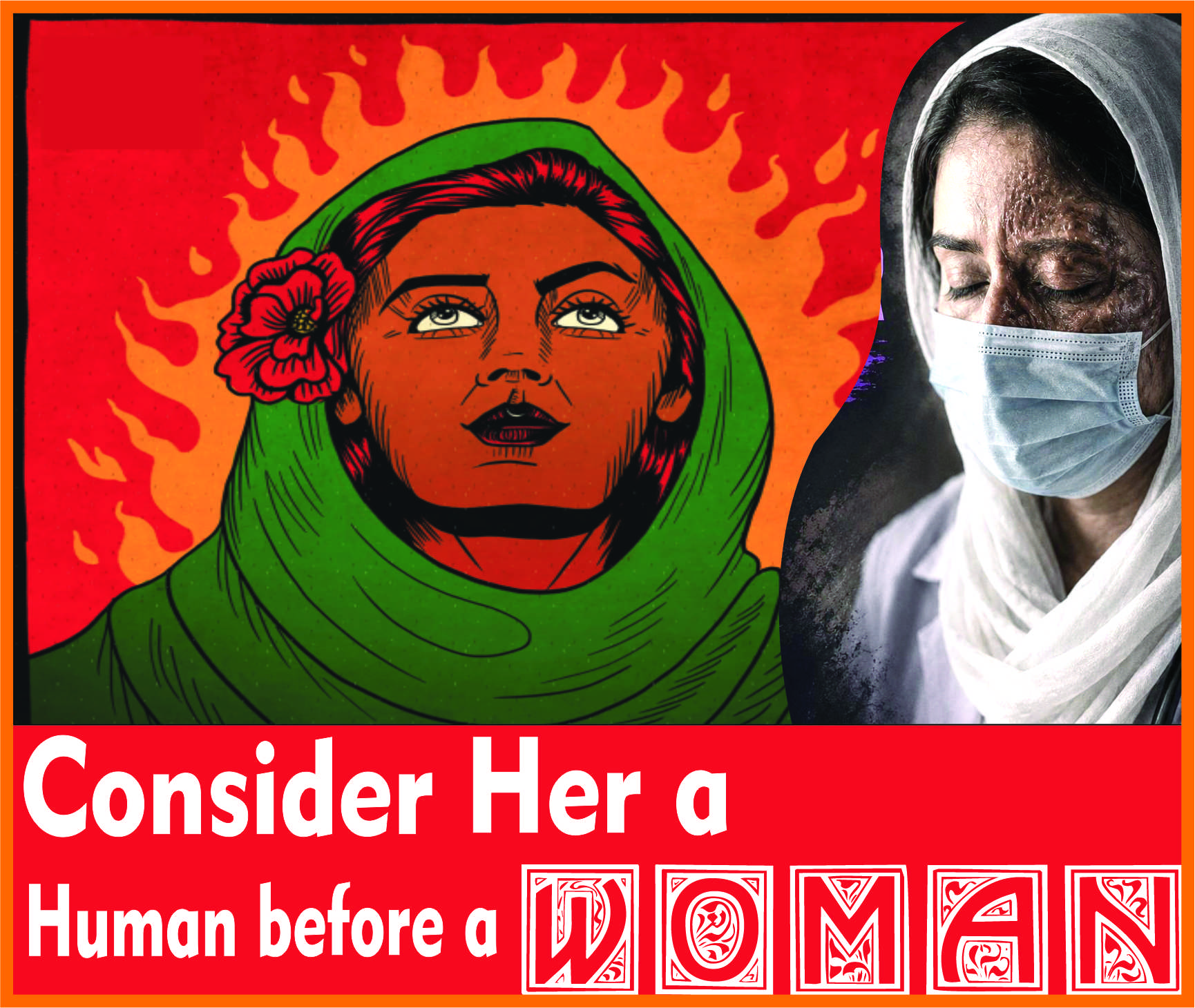
Consider Her a Human before a Woman
Ayesha Khalid
Each time a piece of news about gender-based violence circulates on social media, discourse surrounding women’s rights, gender equality and the curse of a patriarchal society is mobilized. These advocacy campaigns are primarily led by liberal, educated youth. Data and statistical records documenting hundreds of cases across Pakistan are shared and widely discussed within the digital space. While each case has been being highlighted in this manner for the last 3-4 years, the outcome remains unchanged: victim blaming, protracted trial periods, weak enforcement of law and delayed dispensation of justice.
The recent incident of an acid attack on a female doctor in Quetta is enough to boil the blood of an empathetic individual. However, the debate over gender disparity, misogyny and women’s rights is far too complex and extensive to be addressed in a few words. Nevertheless, this piece will focus on the recent incident as a dual problem indicating two different but intersecting dimensions: first, gender-based violence, and second, violence against healthcare professionals in public hospitals.
Gender-based violence is a chronic societal flaw prevalent in South Asian countries, and Pakistan is no exception. The country ranks among the 20 most unsafe countries for women. It occupies one of the lowest positions on the Global Gender Gap Index – the country ranked last (148th out of 148 countries) in the World Economic Forum’s Global Gender Gap Report 2025. This situation persists despite widespread awareness and education facilitated by social media. The common narrative surrounding women remains unchanged when it comes to granting them emancipation and the right to live the life of their choice.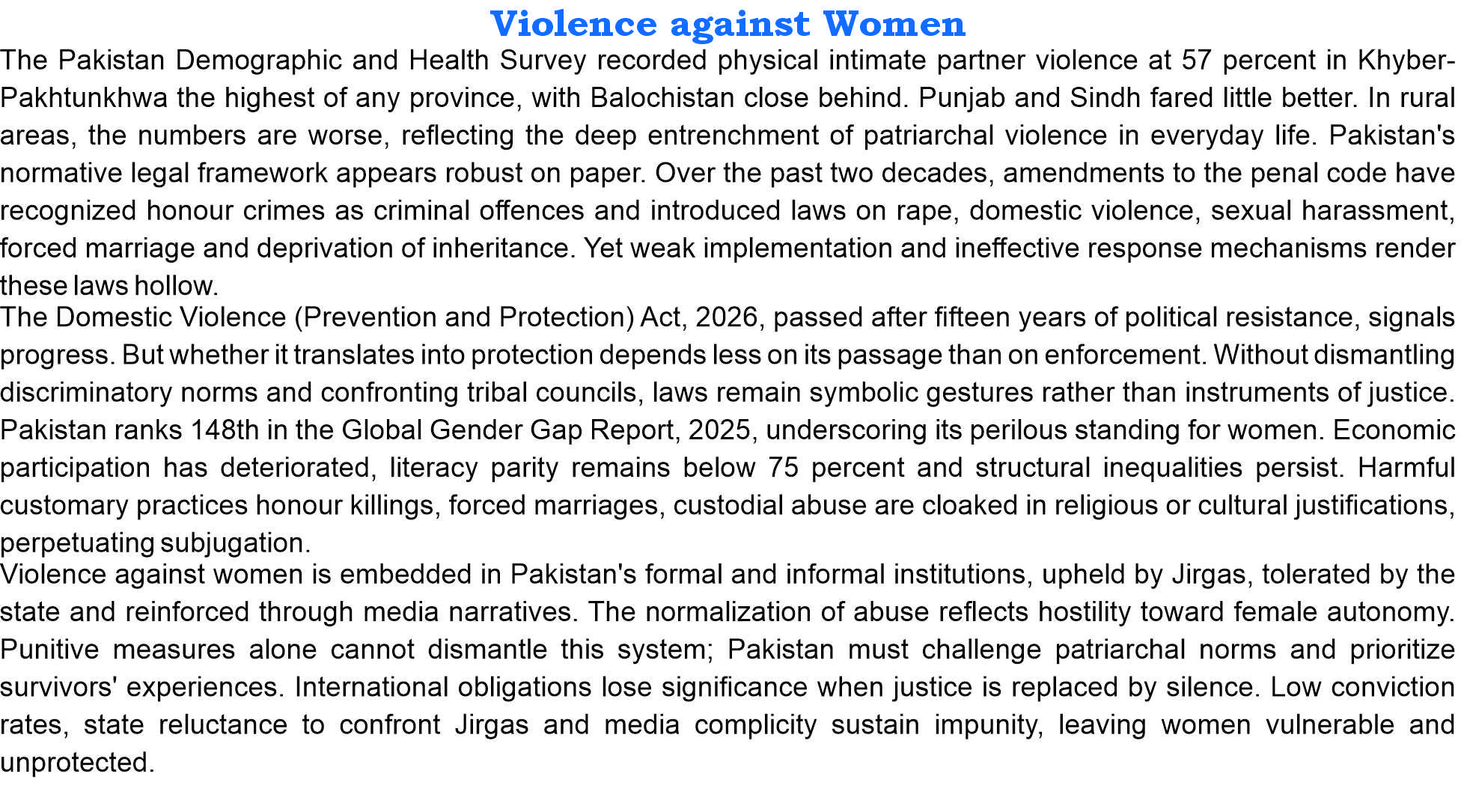
Violence against women is a socially tolerated norm of our society, sustained by biased religious interpretations, cultural dogmas and unequal power distribution between genders. According to a report by the Pulitzer Center, approximately 400 acid attack incidents occur in Pakistan annually, while hundreds go unreported. Women’s lives are ruined systematically due to social stigma, weak institutions and fragile male ego. Sharing facts and calling a human being just a number is insane.
The attack on Dr Mahnoor Nasir is not a single example of violence against women. Rather, plenty of inhuman acts are happening to women across Pakistan. One can hardly imagine how horrendous it is to be a victim, especially a female victim in this society, which only blames the victim and asks baseless questions like, “What was she wearing?” What was she doing there? How does she know him?
On the other side, the conviction rate in such crimes is hardly 1-2%. The problem lives deep in the social, political and institutional roots.
Another grim aspect of our society and law-enforcement entities can be clearly seen in the light of violence cases against healthcare professionals in public hospitals. According to a report by The Lancet, 85% of doctors and 57% of nurses and paramedics in Pakistan experience some form of violence or abuse by patient attendants. Verbal abuse remains the most widespread.
After attacking Dr. Nasir, who was at her workplace, the suspect was killed by the police in an encounter while he was fleeing. This means he cannot be prosecuted or asked about the incentive behind this ghastly act. This dismal situation is showing our deterioration as a society. The men who commit such barbarous crimes are often protected by power, society or state negligence.
A society having such a lame condition of morality cannot stand out as a civilized one. A society whose celebrities are making lame remarks and busy in moral policing of women should use their voices for positive purposes. They should raise voices for taking legal action against these brutalities against women instead of making remarks about their clothing.
“The injustice of the law is that it punishes the victim and rewards the aggressor. The justice of the law must be that the victim is protected and the aggressor is punished.” — Adapted from Simone de Beauvoir
There is a dire need to ensure a 100% conviction rate in all cases of gender-based violence. The curricula of educational institutions should be designed in such a way that we may have a society whose girls are aware and informed of how to seek justice and raise their voices against this violence.
There is a need to create a moderate and sane society that does not question the morality of the victim but rather questions the culprit and his conviction. Moreover, in hospitals, there should be regulations regarding the safety of healthcare professionals in public hospitals. The sale and purchase of acid in the market should be banned for common people. Legal provisions should be made regarding this matter. Women comprise half of the population. No society can become progressive and civilized without protecting half of its population.
“I raise up my voice—not so that I can shout, but so that those without a voice can be heard… We cannot all succeed when half of us are held back.” — Malala Yousafzai