Jahangir's World Times First Comprehensive Magazine for students/teachers of competitive exams and general readers as well.

Indian Ocean and Global Diplomacy
Osama Rizvi
Whether you are an aspiring civil servant or a policymaker in government, geopolitics never ceases to retain its charming relevance. Despite the recent communications revolution and of globalization as it turned the world into a “global village” blurring borders, both have not made any difference to the centuries-old idea from the realm of Realism. Geopolitics stands grim, mocking leaders and fooling analysts all the while becoming more significant.
As our earth is mainly a body placed in water, the importance of oceans, seas, rivers and tributaries is easily discernible. Almost 80 percent of global trade by volume is transported by seas (70 percent in terms of value). Consider the South China Sea, for example, that alone carries $5 trillion of trade annually. Then there are straits, aptly called Choke Points. Consider them as flashpoints where, or due to which, you might see the next sea battle.
Of the 80 percent trade mentioned above, 60 percent passes through Asia and here we have the highway of the seas, Indian Ocean. But before we move towards its diplomatic dimensions and economic linkages, here are some interesting statistics: Indian Ocean is the world’s third largest ocean. There are three choke points in Indian Ocean though which 80 percent of global oil trade passes. It is spread over three continents and covers almost 18 percent of world’s land area. Its importance for fish industry is also considerable as it is responsible for more than 28 percent of fish capture. The container traffic in the region has increased four-folds since the beginning of 2000s. For Pakistan, it brings the monsoon season which is extremely vital for the agriculture sector of the country. The list goes on!
Since it is the crossroads for tankers and handles, a huge chunk of global maritime trade along with the presence of choke points – for which countries would choke each other – makes it clear that the ocean is the venue for the Next Great Game.
The Bigger Picture
While we are discussing the Indian Ocean, we should also discuss a better way to discuss things. A skill that policymakers must have – and civil servants are indeed policy makers (hopefully) – is to connect the dots. You should know why an event in a village of, say Russia, is important for the United States. Assuming it is as a secessionist movement will help readers join the dots. The same case applies here: you should not view the Indian Ocean as a stand-alone body of water having impressive chunks necessary for global economy; it is, in fact, its location, in Asia, that makes it a cynosure of world powers.
The Asian century is about to begin, anew. China is going to be the engin
e of growth for this region with countries like Vietnam becoming the new tiger economies. This concentration of growth and demand from the region raises the strategic value of the Indian Ocean. Then, we have Belt and Road Initiative, the project of the century. New “scramble for Africa” has also begun – many people don’t realize the importance of the continent, even the Mercator map underestimates its size. China is building railways and dams in Africa, India too is doing so. The first Chinese overseas military base is in Djibouti!
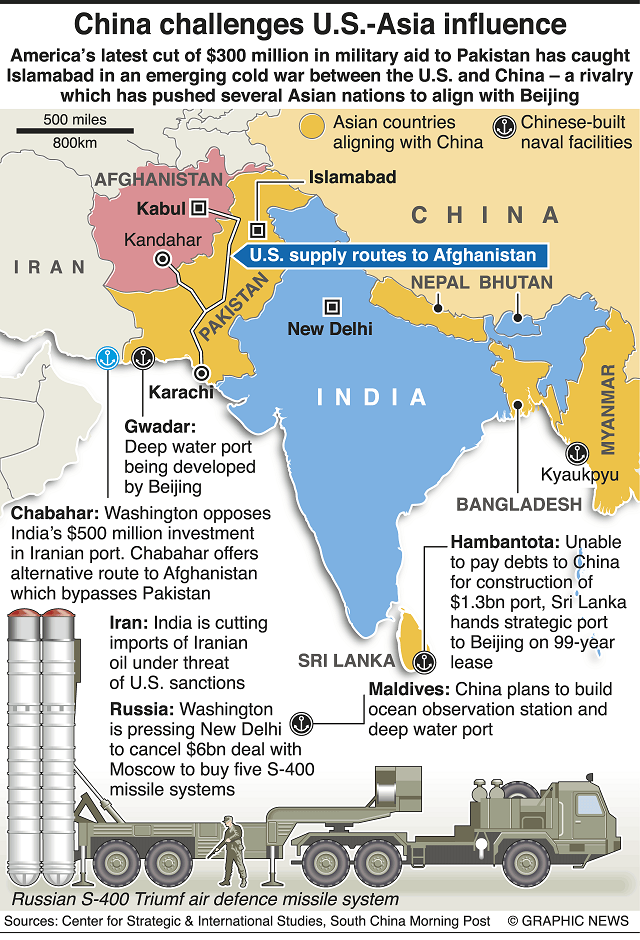
Connect this with the tensions going between Pakistan and India. Look at the atlas and see the Makran Coast; you’ll notice the ports of Chahbahar and Gawadar both lying on it. Both open into the Indian Ocean; hence, its relevance for the archenemies. Suez Canal, Straits of Malacca, Straits of Hormuz and Bab el-Mandeb (Gates of Sorrow) are the choke points through which ships carrying oil and other goods enter the Indian Ocean. This brings in, as stakeholders, countries from the Middle East too.
Mastery of the Indian Ocean is a pivot for any country seeking to, if not control, dominate global diplomacy. India, China, Pakistan, Iran and others, all have set their eyes on this sea. As Robert D. Kaplan has repeatedly pointed out, we should keep a keen eye on this region as future of world dominance might be decided here.
Another important thing is that the Indian Ocean is near to the countries that Nicolas Spykman has called “Rimland” – West is keeping an eye on it too (evidently).
Zooming In and Out
So we need to learn to zoom in and out, especially when handling problems and concepts regarding international relations. Zoom in and you will see the Indian Ocean as a busy maritime highway with trillions of dollars of trade and containers hurtling every single day; you will see how India is eager to take hold of it in an effort to realize its dream of being a global power – which it mistakenly thinks it is – as you start to zoom out, China jumps in with its BRI. Then, there is the African continent – a destination for international investments. The Middle East will suddenly become relevant and finally, directly or indirectly, most of Eurasia.
The world is, fortunately or unfortunately, intricately connected. Nehru said history walks with a thousand feet, the present does too. Whenever you look at a region be it land or sea, even space, always try to bring in a larger perspective. It will, in fact, help you see the matter at hand more clearly.
I’ll finish the article with few suggested readings to understand geopolitics, in general.
- Asia’s Cauldron by Robert D. Kaplan
- Prisoners of Geography by Tim Marshall
- Marco-Polo’s World by Robert Kaplan
- Revenge of Geography by Kaplan
- Essays by Halford Mackinder-His theory of Heartland.
The author is an economic and geopolitical analyst.
He is he founding director of U&I Global and has worked with United Nations on various projects.