 Jahangir's World Times First Comprehensive Magazine for students/teachers of competitive exams and general readers as well.


The fall of Dhaka may have occurred on December 16, 1971, but factors leading to it date far back. The creation of Pakistan came about under extraneous circumstances. The departure of the British from the Indian subcontinent had become imminent after they suffered the economic ravages of WW II while the “Quit India” movement spearheaded by Hindus became louder reaching …
Read More »How do we explain the rise of anti-globalisation?
Martin Jacques In two dramatic developments, 2016 saw the end of globalisation as we have known it. The first was Brexit last May, the decision by the UK to leave the European Union (EU) after 43 years of membership. It came in the only conceivable way it could happen – a referendum. The country’s elected leaders would never have voted …
Read More »Pakistan-India Relations
While the country was divided by political choice, some princely states were given the option to join either Pakistan or India. These included Kashmir, Hyderabad (Dakhan), and Junagadh. India occupied the Junagadh State by force despite its rulers’ desire to join Pakistan. Similarly, India annexed Hyderabad. The Hindu Ruler of Kashmir desired to join India despite a majority Muslim population, …
Read More »Trumpian Uncertainty
Every January, I try to craft a forecast for the coming year. Economic forecasting is notoriously difficult; but, notwithstanding the truth expressed in Harry Truman’s request for a one-armed economist (who wouldn’t be able to say “on the other hand”), my record has been credible. In recent years, I correctly foresaw that, in the absence of stronger fiscal stimulus (which …
Read More »Foreign policy: finding the right balance
Pakistan has continually strived for a balanced foreign policy that looks to keep the objectives of Pakistan as well as the region in perspective. Pakistan realizes its strategic worth as a major player in the region and has always attempted to keep the peace while not letting anyone undermine its integrity or authority. Prime Minister Muhammad Nawaz Sharif has recently …
Read More »Amartya Sen Exclusive Interview By Karan Thapar On Demonetization
This episode of ‘To The Point’ features exclusive interview of nobel prize winning economist, Amartya Sen by Karan Thapar. In this interview Amartya Sen discuss about the aims and achievements of the demonetization as well as its consequences, both that were intended and not intended.
Read More »What the Marshall Plan Can Teach India About the China-Pakistan Economic Corridor
Beyond sketching out the broad considerations, India’s foreign policy planners are yet to study the impact of the China-Pakistan Economic Corridor (CPEC) on South Asia’s politics. New Delhi’s reaction to the CPEC could be divided into two groups: one believes the CPEC serves China’s singular agenda of extending its strategic footprint to Gwadar and beyond, and undermining the chokehold of …
Read More »World Times Institute: Glimpses from MOCK INTERVIEW SESSIONS
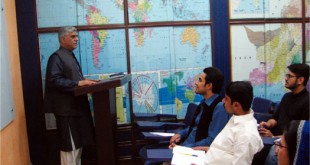
Interview Panel: L-R: Mr Azam Joiya (PSP), Former Addl. IGP, Mr Irfan Raja (FSP), Former Ambassador, Mr Ahsan Raja (PAS/DMG), Former Federal Secretary
Read More »Guess for CSS-2017
English Essay 1. Accountability and democracy 2. Elimination of terrorism and the National Action Plan 3. Building counter-narrative against terrorism and the role of social sciences 4. Higher education in Pakistan 5. Women in civil service 6. Need for electoral reforms in Pakistan 7. CPEC and regional connectivity 8. Future of the United Nations 9. Human development and Pakistan 10. …
Read More »Power Determines Every Relationship in Geopolitics

“Political realism is aware of the moral significance of political action. It is also aware of the ineluctable tension between the moral command and the requirements of successful political action. And it is unwilling to gloss over and obliterate that tension and thus to obfuscate both the moral and the political issue by making it appear as though the stark …
Read More »