Jahangir's World Times First Comprehensive Magazine for students/teachers of competitive exams and general readers as well.

Pakistan-Turkey Partnership and the
Muslim World
Turkish President Recep Tayyip Erdoğan’s recent visit to Pakistan came at a testing time for both countries, and manifested truly the special nature of their fraternal relationship. Pakistan-Turkey ties are rooted in their history and culture going back to the centuries of Muslim rule in India, but a unique emotional dimension of this relationship goes back almost a century ago when, in the 1920s, the Muslims living in India and in areas that later became Pakistan launched Khilafat Movement in support of the Ottoman Empire. The Khilafat Movement was also a factor contributing to the ideological rationale for the creation of an independent state in Subcontinent’s regions where Muslims constituted a majority.
Turkey and Pakistan both have been part of a number of regional blocs during the Cold War and even today are bound together in a multidimensional, close and cooperative relationship with common political, economic and strategic interests. Geographically, they may be two different countries, but their hearts beat together, sharing, as they do, deep affinities of history, religion and culture. What is even more important in today’s context is the globally important unique location that both Turkey and Pakistan enjoy at the confluence of some of the most important regions of the world.
These include the poverty-and-tension-ridden South Asia, conflict-afflicted West Asia, resource-rich, strategically-located Central Asia, economically-pulsating East Asia, stormy and violent Middle East and the oil-rich Persian Gulf. Both Turkey and Pakistan are virtual transcontinental bridges, linking, as they do, at their respective ends the continents of Europe and Asia. With their unique geopolitical location and enormous material and human resources, they have a key role to play, charted for them by their geography as major factors of peace and stability in their respective regions. Linked to their geopolitical importance, both have shared understanding on regional and global affairs.
Both countries are part of restive yet dynamic neighbourhoods, with powerful neighbours and ongoing conflicts threatening to spill, and in some cases spilling, into their borders. Both countries have also had to deal with attempts by other powers to contain their influence, a seemingly natural by-product of their geographical significance. Both have had a colonial power behind a simmering territorial dispute that has become a part of their respective national psyches. Additionally, both also had had to grapple with their identities as Muslim countries in the context of their own cultural perspectives. 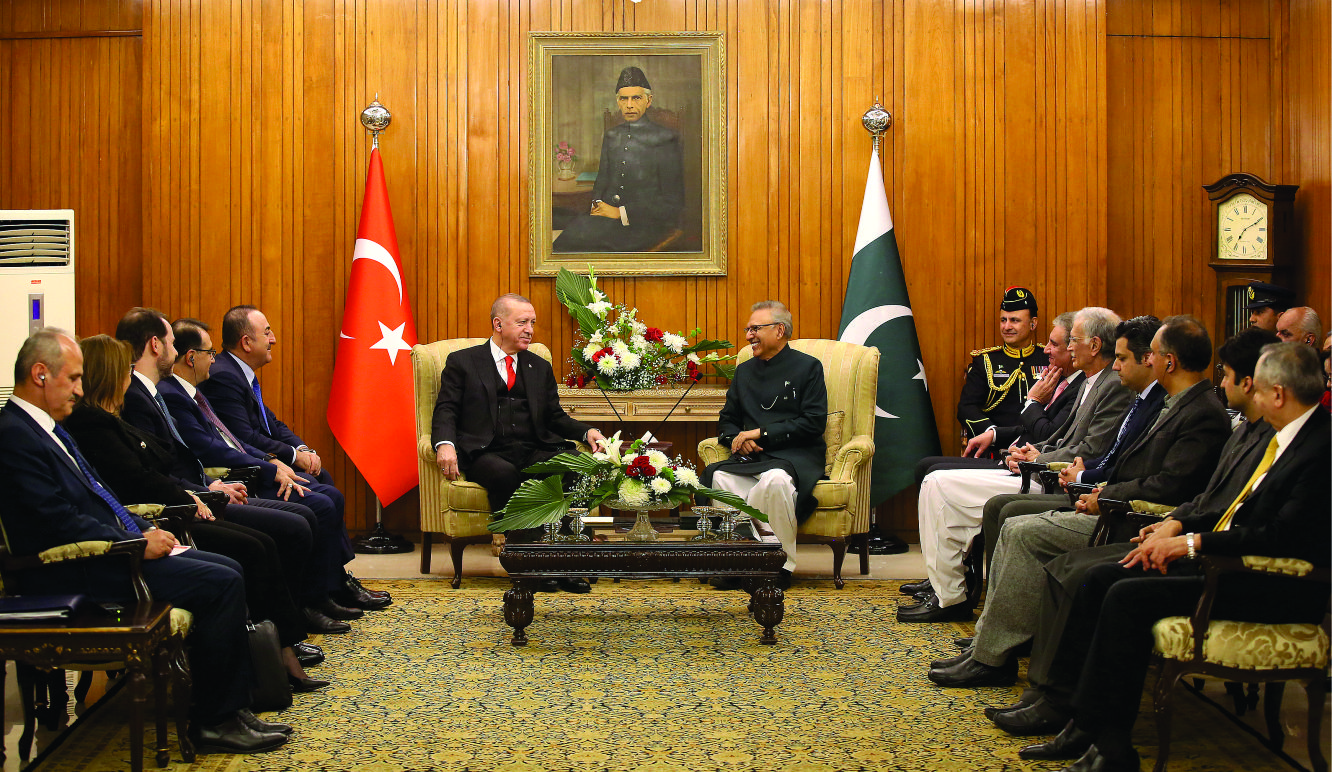
These shared features of their history and geography are a part of, if not the reason behind, the many lessons learned for both countries. No wonder, President Erdoğan’s latest visit to Pakistan provided them an opportunity to go over those lessons and explore how they could, together, play a role as leading players in the Muslim world.
They already have a unique and abiding relationship characterized by mutual support and exceptional trust and understanding. The two brotherly countries have always been each other’s steadfast partners. Turkey supports the cause of self-determination for the people of Indian-Occupied Jammu & Kashmir; and Pakistan stands by Turkey on the question of Cyprus.
Under the leadership of Prime Minister Imran Khan and President Erdoğan, Pakistan-Turkey relations have further fortified into an enduring partnership. They are determined to translate their historic amity into vibrant cooperation in diverse fields, including in the context of combating Islamophobia, promoting Islamic solidarity, and advancing shared goals of regional peace, security and stability.

President Erdoğan’s visit served to underscore the traditional solidarity and affinity between the two countries and proved to be another significant milestone in further broadening of the Pakistan-Turkey strategic partnership. Both sides used this opportunity to place special emphasis on forging a robust economic relationship. Besides agreeing on a strategic economic framework with vast scope for cooperation, the two countries signed thirteen agreements, opening fresh avenues of cooperation in many areas of mutual interest including trade, investment, banking, finance, energy, tourism, culture, science, communication, education, defence, railways, etc.
Prime Minister Imran Khan and President Erdoğan have been able to establish a rapport that can provide them with a joint vision to mobilise a new collective impulse needed for the Muslim world to recover its lost glory and regain clout on the global scene. The challenges are daunting indeed. Peace is the essence of Islam but ironically the Muslim nations have seen very little of it, especially after the Second World War with most of the wars taking place on Muslim soils (Middle East, Iraq, Iran, Gulf States, Afghanistan and Pakistan).
Conflict and violence are pervasive in the Muslim world. The tragedies in Palestine, Kashmir, Bosnia, Chechnya, Iraq and Afghanistan represent the continuing helplessness of world’s Muslims. Since 9/11, Islam itself is being demonised by its detractors with obsessive focus on the religion of individuals and groups accused of complicity or involvement in terrorist activities. Islam is being blamed for everything that goes wrong in any part of the world. With violence and extremism becoming anathema to the world’s high-and-mighty, Muslim freedom struggles of yesterday are now seen as the primary source of ‘militancy and terrorism’.
Representing one-fifth of humanity as well as of the global land mass spreading over 57 countries and possessing 70 percent of the world’s energy resources and nearly 50 percent of the world’s raw materials, the Muslim world should have been a global giant, economically as well as politically. Instead, it represents only 5 percent of world’s GDP. Though some of them are sitting on top of the world’s largest oil and gas reserves, the majority of the Muslim countries are among the most backward in the world.
Mostly, poor and dispossessed nations emerging from long colonial rule may have become sovereign states, but they still lack genuine political and economic independence. Their lands and resources are still being exploited by the West. What aggravates this dismal scenario is the inability of the Muslim world as a bloc to take care of its own problems or to overcome its weaknesses. Its rulers have mortgaged to the West not only the security and sovereignty of their respective countries but also the political and economic future of their nations.
But things now have come to the boiling point. The winds of change are already sweeping across the long-tormented Arab world. Alarm bells are ringing loud and clear from the Maghreb to the Arabian Peninsula. The 21st century will belong to whosoever makes the best use of its challenges and opportunities. Angels will not descend to help it or salvage its difficulties. There is an urgent need for Muslim countries to commit themselves to scientific and technological advancement. They must also take control of their own resources.
This, in fact, is the crux of the challenge that lies ahead not only for Pakistan and Turkey but also the other most influential Muslim countries in the world which include Iran, Saudi Arabia, Qatar, Malaysia, Indonesia and Egypt. They have the potential to lead the process of change in the Muslim world. But this requires statesmanship of exceptionable calibre that can rise above vested interests and divisive tendencies to be able to forge a fresh collective impulse that leads the Muslim world into a new era of unity and strength to make it a strong, cohesive global entity in political, economic and security matters
Prime Minister Imran Khan of Pakistan, Prime Minister (former) Mahathir of Malaysia and President Erdoğan of Turkey alone promise the needed statesmanship that can bring the Muslim world together. They should jointly work out a framework of cooperation for the entire Muslim world in the fields of education, economy, science and technology, economy and counter-terrorism.
The writer is a former foreign secretary.