Jahangir's World Times First Comprehensive Magazine for students/teachers of competitive exams and general readers as well.

Digital Pakistan Vision
Zafrullah Saroya
Digital technology has already made significant headways around the world. It is boosting industrial and agricultural productivity across the globe, revolutionising healthcare and education, and enabling smart young men and women with little cash in their pockets to create billion-dollar companies. An example of the wonders of this technology can be seen in sub-Saharan Africa. For instance, in Ghana, digital technologies have impacted the agriculture sector. Farmerline and Farmable are agri-techs that have pursued the development of new farming businesses while renewing the existing ones. In Nigeria, Prime Wave supplies equipment to rice processing firms while Al-Wabel Trading Company Ltd is inventing new technological solutions. But it is sad to note that while the advancements of technology are being used by countries in all continents, they have not yet anchored in Pakistan. The country has failed to adopt digital technology the way it should have and keep pace with its advancement.
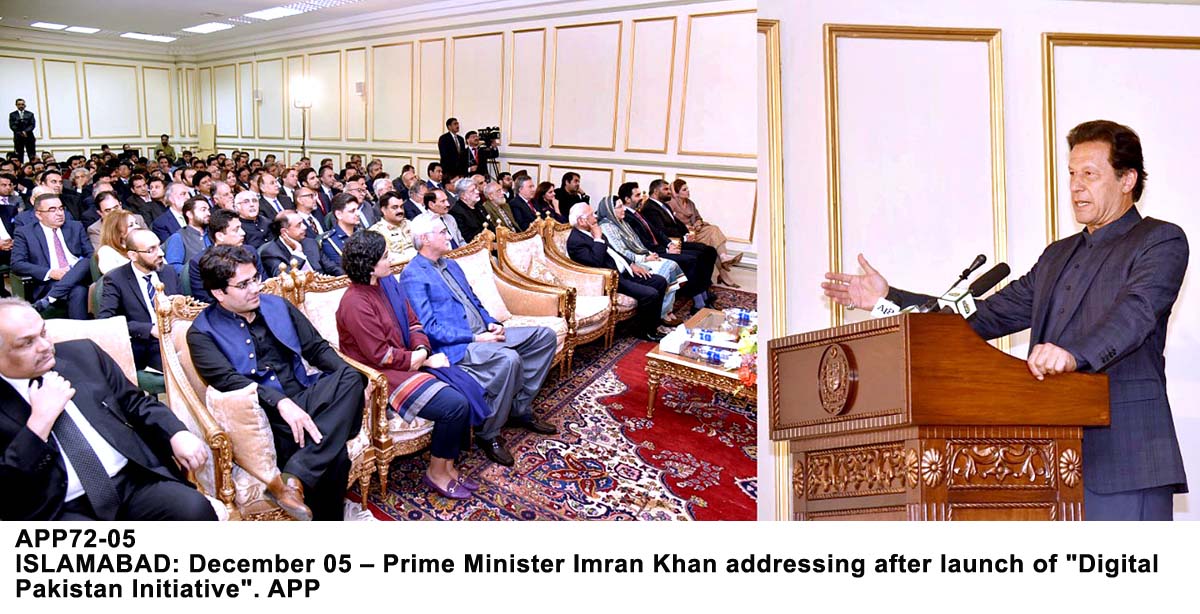
Digital technology is reshaping the world rapidly. It is transforming everything — from the way governments and citizens interact to how markets behave and consumers shop and pay their bills. It is boosting industrial and agricultural productivity across the globe, revolutionising healthcare and education, and enabling smart young men and women with little cash in their pockets to create billion-dollar companies. We have witnessed weaker economies flourish by taking the right decisions at the right time in the last one decade. So, adoption of modern technologies is a prerequisite for Pakistan as well, if we want to keep pace with other countries. It was in this backdrop that Prime Minister Imran Khan launched, on December 05, ‘Digital Pakistan’, a government initiative aimed at introducing latest technology for public welfare. Providing welfare and housing are necessary and commendable initiatives in their own right, but they seek to mitigate the symptoms of a country struggling with economic prosperity, not seek to change the conditions that lead to hardship in the first place. Creating new jobs, teaching modern skills and creating infrastructure to facilitate economic activity is the more prudent and long-term solution, and it is encouraging to see the government taking such a holistic step. While addressing the launching ceremony, Prime Minister Imran Khan described the project as one that would unleash the full potential of women and young people in the economy. This, he said, would be done by using e-governance as a tool to promote inclusion and do away with various forms of graft, while admitting that a few cybersecurity hurdles still needed to be addressed.

Introduction
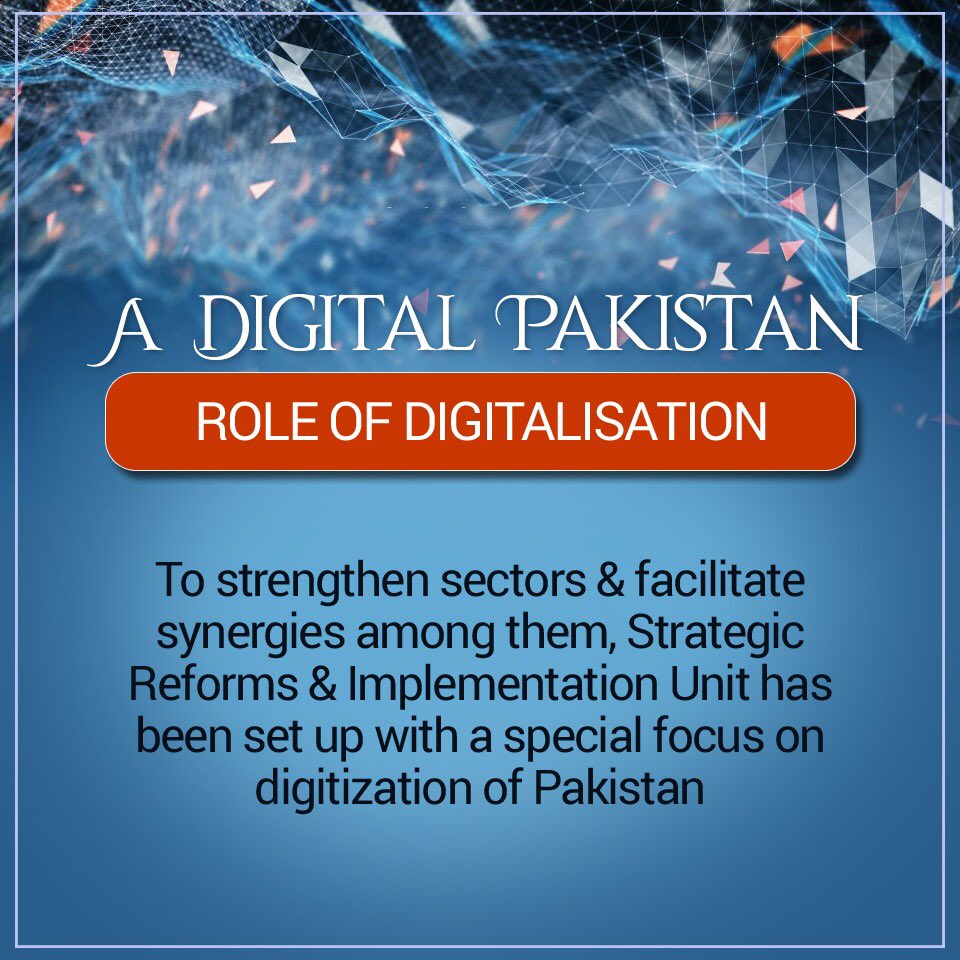
The Digital Pakistan vision sets Pakistan’s digital ambition and has been designed for the government and the private sector to work towards a digitally progressive and inclusive Pakistan by enhancing connectivity, improving digital infrastructure, investing in digital skills and literacy, and promoting innovation and entrepreneurship. It brings together multiple initiatives that the government has already kicked off, and identifies additional focus areas that the government would initiate in the coming months.
Strategic Pillars
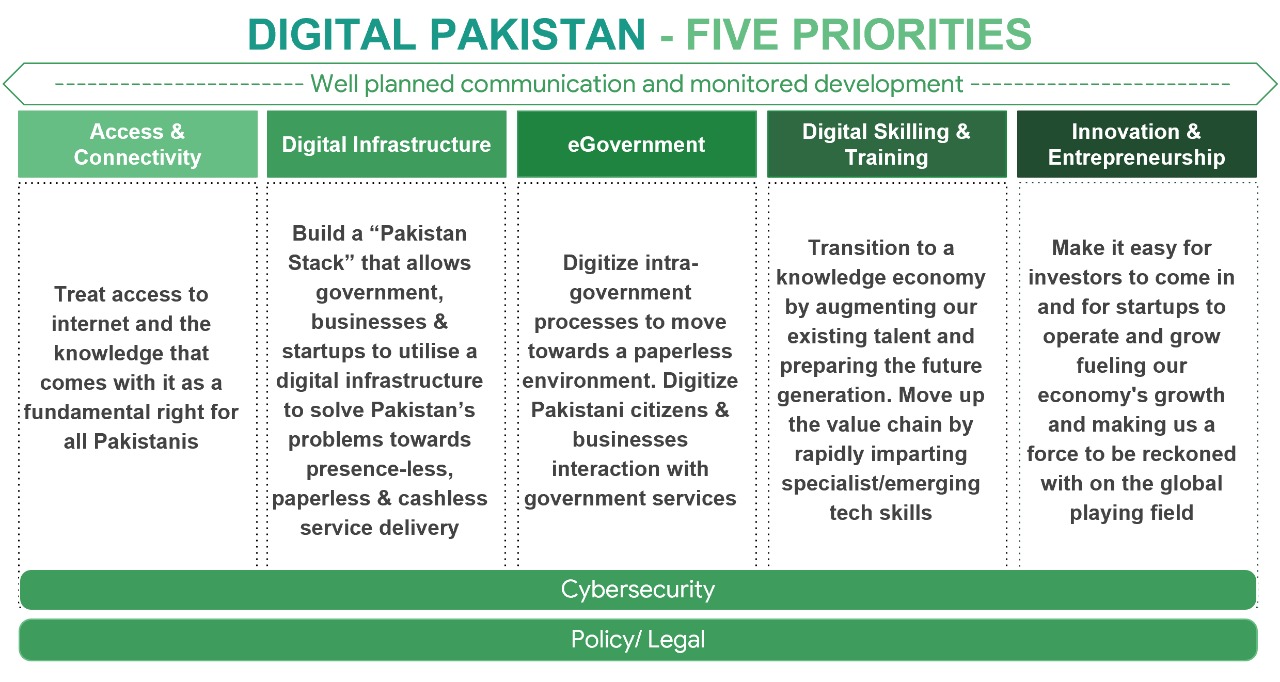
Its strategic pillars are access and connectivity, digital infrastructure, digital skill and literacy, innovation and entrepreneurship. These pillars, supported by a forward-looking policy and a broader legal framework, will set Pakistan on the path to becoming a truly Digital Pakistan.
- Access and Connectivity to ensure every Pakistani has access to internet – a fundamental right – to make available universally and especially to underserved populations
- Digital Infrastructure that creates the ability to undertake daily tasks using smartphones in a secure and faster manner
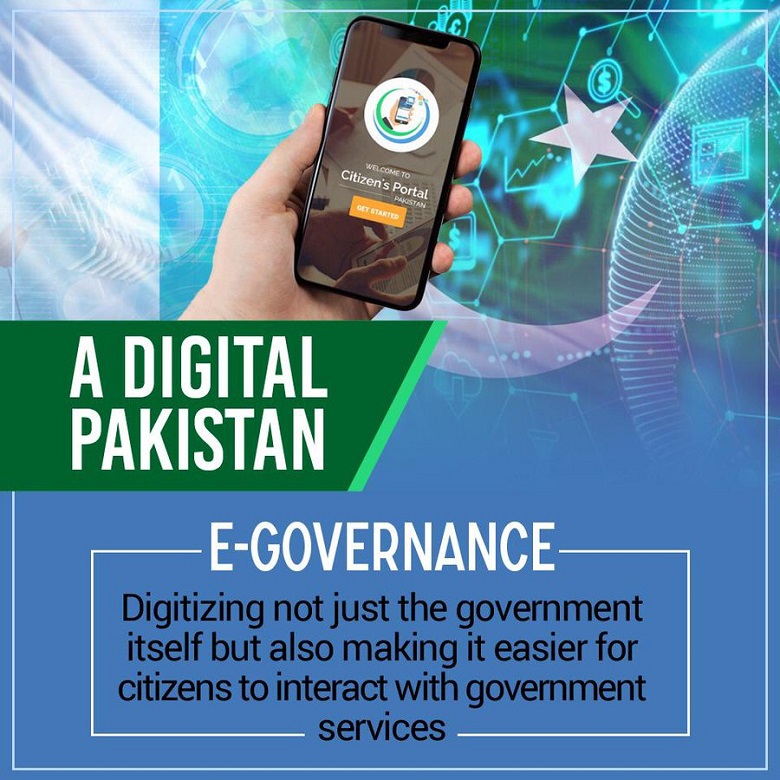
- E-government that digitizes intra-government operations and processes towards a paperless and efficient environment, and also digitizes government services for citizens and businesses for better delivery
- Digital Skills and Literacy that enables tech graduates to secure relevant jobs
- Innovation and Entrepreneurship to provide an enabling environment for startups to flourish
Potential in Pakistan
Pakistan is already among the top performers and users of technology in the world and the information technology industry in the country is doing well and competing favourably with those of other countries like Singapore, Indonesia, China, Malaysia and even India. What we have so far achieved in the field of IT and telecommunication is mainly because of the visionary approach of then Minister for Science and Technology Dr. Atta-ur-Rehman who convinced the then Government to make substantial allocations for S&T and especially IT and telecom. It was because of his efforts and hard work that the country was placed on the map of IT world but regrettably the tempo was not maintained by the succeeding governments and as a result we could not realize the export targets for software as envisioned in the first IT policy. Pakistan, which has about 60% of its 200 million population in the 15 to 29 age group, represents an enormous human and knowledge capital. Pakistan has more than 2000 IT companies and call centres and the number is growing every year. Pakistan has more than 300,000 English-speaking IT professionals with expertise in current and emerging IT products and technologies.
More than 20,000 IT graduates and engineers are being produced each year. All this shows the potential is there and what we need is clear-cut policies and their implementation in letter and spirit. Prime Minister Imran Khan has boldly acknowledged that he should have launched the digital Pakistan initiative much earlier because it was last year that the Ministry of Information Technology came out with the Digital Pakistan Policy, comprehensive document covering all aspects of the issue. It is often said and rightly so that we are quick at formulating and launching policies, visions and initiatives but pay only lip service to actual implementation. The things are likely to change as the Prime Minister has assigned the responsibility of implementation to a vibrant lady Tania Aidrus, a senior Google executive who quit her position to lead the initiative. Five strategic pillars of the initiative – access and connectivity, digital infrastructure, digital skilling and literacy, innovation and entrepreneurship – as identified by her, show that the Government was determined to make ICT a broad enabler of every sector of socio-economic development.
Challenges
Having begun their journeys as independent nations at the same time, Pakistan can find easy comparisons with the rest of South Asia. While its geopolitical conditions and unique demographics may have led it to lag behind the rest of the Subcontinent on a holistic scale, where Pakistan has shown the greatest lack of foresight and innovation has been in the field of digital communications and commerce. India’s timely investment into IT universities is now producing a steady stream of IT professionals that find employment all over the world, as well as in India. Its cheap, skilled, young and plentiful labor has resulted in it becoming a hub of technology companies from across the world – a model that Bangladesh was quick to adopt. We have been way off our schedule towards progress.
One reason for this fiasco was a lack of vision, which is a limitation facing all sectors. The gatekeepers and leaders of the many sectors are themselves naïve and unable to foresee the change that must come.
Making the Vision Work
Slow internet bandwidth and speed with a limited broadband penetration has been hampering such growth. While the metropolitan cities including Karachi, Lahore, Islamabad, Multan and even Hyderabad has internet connections, broadband connectivity has yet to reach the rural areas. The government did pursue digitization but could not make headways. The first and foremost role of the government in promoting Digital Pakistan is to broaden digital access. The access, in turn, depends on the availability of high-quality broadband network and affordable services and smart phones. There are 163 million cellular subscribers, out of which only 73 million use the 3G/4G services. With a 3G/4G network coverage of approximately 70%, this means that there are still 41 million potential users who are excluded. And to make them a part of Digital Pakistan, they need to have access to broadband network and smartphones.
Regulatory duties on mobile phone imports and massive devaluation have pushed the smartphone prices beyond the reach of millions. The price of the cheapest smartphone now stands at about Rs15,000 with the government taking away Rs2,700 as taxes. The smartphone penetration has therefore started dropping and the 10 million smartphones imported in 2017 have now reduced to less than 5 million sets in 2019. Revenue considerations often take precedence over other policy goals. But ironically, in this case, the foregone revenue in terms of telco service tax and sales tax exceeds the duties collected.
Then comes the issue of network coverage and affordability of services, which in turn depend on telcos. Rather than incentivising them to enhance their coverage and make their services more affordable, the government has locked horns with them on the issue of spectrum licensing. The government is pushing for a price tag of $450 million per block compared to $291 million in 2004, but cellular companies claim that this means a whopping 2.5 times increase over 15 years, as they earn their revenues in rupees. Even if the government wins the case, the telcos would most likely pass on the cost to the consumers, adversely impacting the affordability of the services.
If the government is serious about Digital Pakistan, this issue needs to be resolved and the best way would be to rationalise the prices, with more ambitious roll-out obligations for telcos to improve their coverage.
Conclusion
Good intentions and ambitious policy goals without the requisite implementation capability means nothing. To implement the Digital Pakistan initiative, we need concerted efforts by multiple provincial and federal departments and agencies. But if the past is of any evidence, this is where most of the policies fail. We have a great track record of well-drafted policies, cutting-edge regulations and modern laws, but when they pass through the filter of implementation, they somehow translate into poorly executed projects without much impact on ground.
Tania Aidrus
Prime Minister Imran Khan has launched a new Digital Pakistan project to digitize government infrastructures in Pakistan. The project promises paperless and efficient environment including services for citizens and businesses for better delivery. The government has hired a senior ex-Google employee, Tania Aidrus, to head the campaign. Tania Aidrus has resigned from her previous position as Director, Product, Payments for Next Billion Users at Google. Prior to that, she was the Country Manager for South Asia Emerging Markets at Google.

Tania Aidrus, an ex-Google executive, has been put in charge of Prime Minister Imran Khan’s new initiative intended to herald a technologically driven environment for the tech savvy youth of Pakistan. Aidrus has lived outside Pakistan for the last 20 years, but now she wants to see the country on the world map of technology.
Aidrus completed her Bachelors in Biology after leaving Pakistan and later moved towards economics having received the same degree from the US-based Brandeis University.
She then did her MBA from the Massachusetts Institute of Technology’s Sloan School of Management. It was at MIT when she first started to translate her intentions to contribute to Pakistan into actions.
According to her LinkedIn profile, Aidrus started her career as a research associate for a technological consultancy, First Consulting Group, and developed her expertise to later become a senior consultant for a Washington-based management and information technology consulting firm, Booz Allen Hamilton.
Aidrus also founded a mobile health diagnosis start-up, called ClickDiagnostics. She found her calling in working from Google’s platform for her native country.
Her journey advanced to the global spectrum when she first got the chance to professionally help Pakistan emerge on the tech landscape, which saw her move from the US to Singapore as Google’s country manager.
She also led the Global Business Organization at Google in the US and later in Singapore as the Country Manager for Google’s South Asia Frontier Market.