
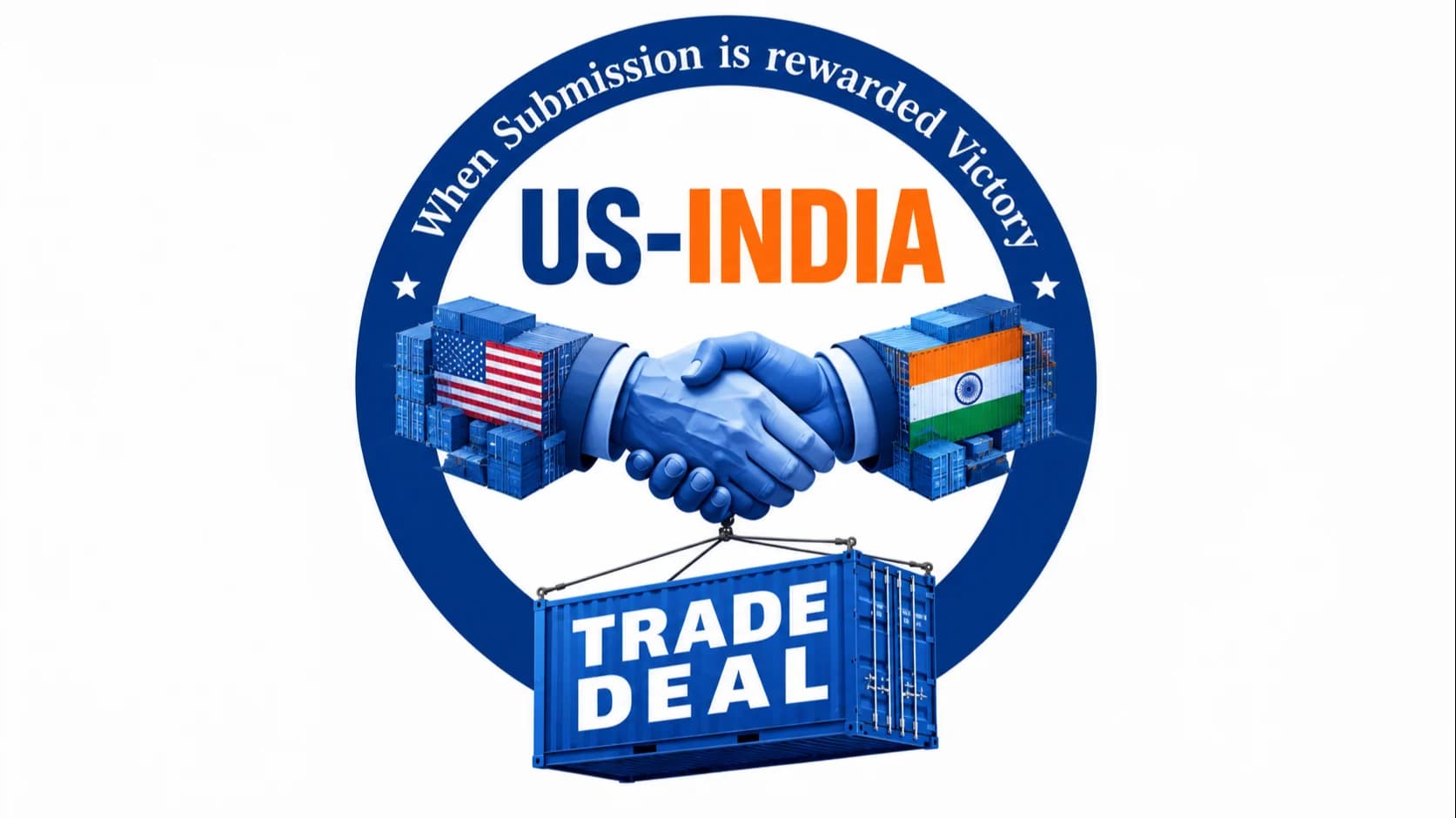
Just days after the India-EU trade deal, the leaders of the United States and India, in a phone call, reached a framework for an interim agreement on reciprocal trade and reaffirmed their commitment to broader US-India Bilateral Trade Agreement (BTA) negotiations. President Trump announced the deal, saying New Delhi agreed to stop buying Russian oil and may purchase it instead from Venezuela – The United States is effectively overseeing Venezuelan oil exports since toppling the South American country's leader Nicolas Maduro in a military operation in January. Trump added that “out of friendship and respect” for Modi, the US would lower its reciprocal tariff rate from 25% to 18%, while India would reduce tariffs on US goods to zero.
The Context and Backdrop
The announcement comes after months of escalating trade sanctions, triggered by Washington's dissatisfaction with India's energy sourcing and broader trade imbalance. The dispute dates back to early 2025, when the Trump administration, pursuing a tough trade agenda, launched a series of tariffs under what it called “reciprocal tariff” policies aimed at reducing the US trade deficit with major partners. Here is a timeline of events:
3 April 2025: The US announced 27% 'reciprocal' tariffs on India.
o The United States Trade Representative (USTR) report on trade barriers criticized India's high applied tariffs on a wide range of goods.
9 April 2025: Trump announced a 90-day pause on reciprocal tariffs on 75 countries, including India.
10 May 2025: India and Pakistan agreed to an immediate ceasefire following days of high-level military escalation along the border. Trump brokered the truce, saying that he used tariff leverage.
31 July 2025: Trump announced a 25% tariff on Indian goods from August 1, with an additional but unspecified “penalty” for its defence and energy imports from Russia.
7 August 2025: Trump increased the tariff from 25% to 50% on Indian goods shipped into the US.
o The primary trigger for punitive duties on Indian exports was New Delhi's continued import of discounted Russian crude oil.
o Trump consistently labelled India as the 'tariff king', suggesting that American companies such as Harley-Davidson did not excel in India due to high tariffs.
2 February 2026: President Trump and PM Modi announced the commencement of bilateral trade agreement negotiations and indicated that a settlement will appear by year end.
How It Happened?
Despite several rounds of talks, disagreements persisted through 2025, with Trump repeatedly warning that tariffs could rise further unless India cut Russian oil purchases. The situation pushed US–India relations to one of their lowest points in years, with Indian officials calling the tariffs “unfair and unjustified” and defending their energy policy as aligned with national interests.
The impasse eventually opened the door to a deal in early 2026, with tariffs being reduced as part of a broader agreement on trade and energy cooperation.
10 Key Takeaways
Here are the 10 key takeaways from the India-US interim trade framework:
1. Tariffs on Indian goods set at 18%
The United States will apply a reciprocal tariff rate of 18% on several Indian exports, including textiles, leather, chemicals, plastics, machinery, home décor and artisanal products, significantly lower than previously proposed levels.
2. Pathway to remove tariffs on key sectors
Washington may remove reciprocal tariffs on products such as generic pharmaceuticals, gems and diamonds and aircraft parts once the interim agreement is successfully finalized.
3. India to cut duties on US goods
India has agreed to eliminate or reduce tariffs on all US industrial goods and a wide range of agricultural products, including tree nuts, fruits, soybean oil, wine, spirits, dried distillers' grains and animal feed.
4. $500 billion trade and purchase plan
India intends to purchase $500 billion worth of US energy products, aircraft and parts, precious metals, coking coal and technology goods over the next five years, a move expected to significantly boost bilateral trade but very challenging for India.
5. Preferential market access for both sides
Both countries have committed to providing sustained preferential market access in sectors of mutual interest, reinforcing a more reciprocal trading relationship.
6. Relief on aircraft and auto components
The US will remove certain national security tariffs on Indian aircraft and aircraft parts. India is also expected to receive a preferential tariff-rate quota for automotive parts, subject to US security requirements.
7. Focus on pharmaceuticals
India could secure negotiated outcomes for generic drugs and pharmaceutical ingredients depending on the findings of an ongoing US Section 232 investigation.
8. Tackling non-tariff barriers
India has agreed to address long-standing regulatory hurdles affecting US medical devices, simplify restrictive import licensing for information and communication technology goods and review standards to ease American exports. Both sides will also work to resolve barriers impacting US agricultural trade.
9. Stronger supply chains and tech cooperation
New Delhi and Washington plan to deepen cooperation in advanced technology, including graphics processing units (GPUs) and data centre equipment, while aligning policies to enhance economic security and supply chain resilience.
10. Roadmap for a full trade pact
The interim agreement is designed as a stepping stone toward a comprehensive Bilateral Trade Agreement. Both nations will establish rules of origin, align standards, address digital trade barriers, and expand market opportunities during the next phase of negotiations.
Challenges
The "Strategic Autonomy" Dilemma: The deal's success is contingent on India halting or significantly reducing Russian oil imports. This risks straining the "Special and Privileged Strategic Partnership" with Moscow, which remains India's largest defense supplier.
o This also underscores the challenge to India's de-hyphenated foreign policy, which it claims to pursue to maintain independent, multi-aligned relationships rather than aligning exclusively with any single power bloc.
Transactional Diplomacy: The "Reciprocal" nature of the deal (matching tariffs to 18%) suggests that the US now views India through a purely transactional lens.
o This could set a precedent where every strategic concession requires a massive economic or political "payback."
China Retaliation: As India cements its role as a "China Counter," Beijing has already warned of consequences.
o Given India's import dependency on China (especially for REEs and API pharmaceuticals), any retaliatory trade barriers from China could cripple Indian manufacturing.
Regional Parity: India remains disadvantaged as competitors such as Bangladesh and Vietnam enjoy a special GSP (Generalised System of Preferences) concession of about 5%, withdrawn from India in 2019, raising doubts over true regional parity.
Economic Risks: The US has claimed India committed to reducing tariffs to "zero". Opening India's dairy and poultry sectors to highly subsidized US agri-products could trigger widespread rural distress and farmer protests, which have historically been protected.
o Russian oil was purchased at a discount, providing a cushion against global inflation. Shifting to US or Venezuelan oil will increase India's import bill, potentially impacting the current account deficit.
Regulatory and Technical Barriers: Even with lower tariffs, US "Sanitary and Phytosanitary" (SPS) standards often act as invisible walls for Indian food and pharma exports. The deal does not yet fully address these technical hurdles.
o This deal might eventually require India to align its Intellectual Property laws with US interests, potentially raising healthcare costs.
Digital Trade: Issues regarding data localization and India's DPDP Act (2023) remain sticking points. The US tech giants seek "free flow of data," which India may find conflicting with its national security and privacy frameworks.
Is $500bn Purchase Pledge Realistic?
Under the framework, India has expressed an intention to buy $500 billion of US goods over five years, including energy, aircraft, technology products and coking coal. This is hardly achievable, as this would require India's annual imports from the US to more than double every year. The announcement also relies on private sector decisions that are beyond government control. The commitment also risks inflating India's import bill and eroding its trade surplus with the US, and will have longer-term pressure on its external balances.
Implications for Pakistan
For Pakistan, these developments carry important implications. The United States is Pakistan's largest single-country export destination, with imports from Pakistan exceeding $5 billion and a trade surplus of around $3 billion in Pakistan's favour. The current agreement, together with a more comprehensive US-India deal expected next month, could therefore have significant consequences. Any change in tariff structures or market access conditions in the US market directly affects Pakistan's most critical export sectors, particularly textiles and apparel.
Despite this strategic importance, Pakistan has never made a serious effort to negotiate a comprehensive bilateral trade agreement with the United States. Instead, it has relied on seeking unilateral tariff preferences or proposing narrow and largely symbolic arrangements covering a limited number of products.
These fig leaf agreements, similar to those Pakistan has pursued with several other partners, have yielded little in terms of sustained market access or export diversification and have left the country increasingly marginalized in global trade.
These developments underscore the need for Pakistan to fundamentally rethink its trade policy. In the past, such a shift was constrained by a highly protectionist tariff regime that made meaningful liberalization politically and economically difficult. With deep tariff reforms now underway, however, the landscape has changed.
Pakistan is better positioned than before to engage in substantive negotiations with major trading partners, including the United States. The challenge is no longer feasibility but political will, namely the willingness to move beyond ad hoc preferences and symbolic deals towards comprehensive and forward-looking trade agreements.
Analysis
India's trade agreement with the United States reflects strategic compulsion rather than strategic choice, as PM Modi had little room for maneuver following India's diplomatic and strategic setbacks after the May 2025 India-Pakistan conflict. The agreement emerged after India found itself increasingly isolated in the aftermath of the conflict, with bilateral tensions and international scrutiny narrowing New Delhi's diplomatic space.
India sought to diversify its external partnerships by improving trade relations with China, strengthening its engagement with Russia and concluding a long-pending free trade agreement with the European Union. However, coercive diplomatic pressure from Washington accelerated the US–India trade arrangement, which is largely favorable to American economic interests.
Under the agreement, US tariffs on Indian goods and services have been reduced to 18 percent, while India has eliminated tariffs on American goods and services altogether, effectively opening its domestic market to US investors and entrepreneurs. India has also committed to investing approximately $500 billion in the United States across key sectors, including technology, agriculture, and energy – a significant strategic and economic gain for Washington.
For a country that had crossed long-standing red lines, particularly in agriculture, where tariff protections had historically been regarded as politically and economically sensitive, these concessions will pose serious domestic challenges for Prime Minister Modi, especially in convincing India's farming community that such measures would not undermine their livelihoods.
The agreement, coupled with India's free trade arrangement with the European Union, could expose vulnerable sectors of the Indian economy to intense external competition. These agreements might disproportionately affect marginalized and lower-income communities, while simultaneously facilitating an influx of luxury goods, advanced technologies and industrial products from Western markets at highly competitive prices.
The United States has secured commitments from India, which previously continued substantial oil purchases from Russia despite public assurances to the contrary, to gradually reduce its reliance on Russian oil and shift energy imports toward American and alternative suppliers. The new arrangement marks a significant recalibration of New Delhi's foreign policy priorities, as its foreign policy narrative of “strategic autonomy” has increasingly come under scrutiny, with critics within India arguing that recent policy decisions have pushed the country toward what they describe as 'strategic uncertainty' and 'economic vulnerability'.
Conclusion
India-US deal, which is being presented as a step toward strengthening economic cooperation and energy security, signals a reset in relations between the two countries after a period of strain marked by steep US tariff threats, a proposed $100,000 fee on H-1B visa applicants and shifting regional dynamics. The US appears to have reduced its earlier tariff threat of 50% to 18%, while India has agreed to lower barriers for selected American exports and expand purchases of US goods, including energy supplies. Tariff concessions reportedly cover items such as nuts, fruits, vegetables, and wine, opening significant opportunities for US producers in India's vast consumer market. However, India has shielded politically sensitive sectors including rice, beef, soybeans, sugar and dairy. Moscow's statement denying any confirmed shift in India's oil purchases has added uncertainty. Overall, the agreement is viewed as a cautious diplomatic reset, though its durability and precise commitments remain unclear.
Pakistan must remain vigilant in the wake of this engagement. Pakistan had made notable diplomatic gains in Washington over the past year, strengthening its engagement with US policymakers and enhancing mutual confidence, particularly with President Trump and key decision-making circles. However, it is also true that India maintains significant influence within US political and policy institutions and may attempt to use its renewed strategic engagement with Washington to create diplomatic pressure on Pakistan. Islamabad should continue proactive diplomacy and economic reform to consolidate its strategic gains and maintain balanced relations with global powers. While the agreement represents a tactical diplomatic recovery for New Delhi, it simultaneously signals shifting geopolitical alignments in South Asia and underscores the need for Pakistan to remain alert, strategically agile and diplomatically engaged in an increasingly competitive regional and global environment.
The writer is a member of staff.