
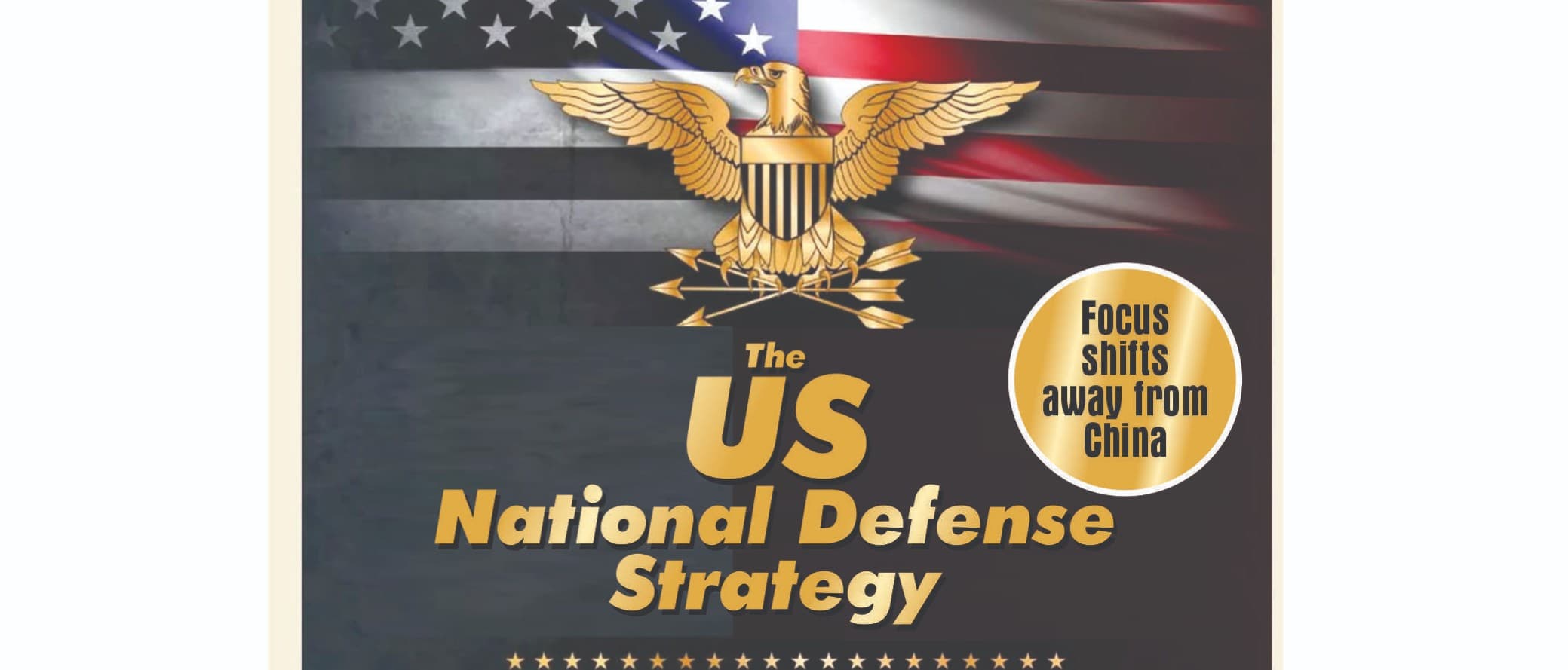


On January 23, 2026, the US Department of War released a priority-shifting National Defense Strategy (NDS) that chastizes US allies to take control of their own security, and reasserts the Trump administration's focus on dominance in the Western Hemisphere above a longtime goal of countering China. The 34-page document, the first since 2022, signals shifts in US defense strategy and priorities compared to past administrations — including notable differences in how the document discusses the People's Republic of China (PRC). Nevertheless, the NDS continues to emphasize the importance of deterring China in the Indo-Pacific, not through confrontation but through strength. “We will deter China in the Indo-Pacific through strength, not confrontation,” the document says.
Overall, the NDS elaborates a roadmap to implement the White House's National Security Strategy (released in late 2025), though it has some new points of emphasis, some notable elaborations of key objectives and several glaring omissions which reflect altered priorities or impulsive, personality-driven initiatives.
An Overview
Put simply, the unclassified Strategy is the Donroe Doctrine made manifest. The "rules-based international order" is dismissed as an "abstraction," and the emphasis is on hard power close to home. Inside the document, homeland defense is often perched above or before China and Russia, typically considered top threats. "For too long, the US government neglected — even rejected — putting Americans and their concrete interests first," it begins.
Here are some of the most eyebrow-raising takes in the strategy:
It denies isolationism while also promising that the military will no longer be "distracted by interventionism, endless wars, regime change and nation building."
It's similar to the pledge Defense Secretary Pete Hegseth made at the Reagan National Defense Forum in December.
It cites in one sentence the "speed, scale and quality of China's historic military buildup" and in the next notes the goal is "not to dominate China; nor is it to strangle or humiliate them." Another promises robust defenses along the first island chain, including Japan, Taiwan and the Philippines.
It alludes to a change in posture on the Korean Peninsula, on the heels of multiple reports that the US would withdraw some of its forces there.
It makes clear that American access to the Panama Canal and Greenland is paramount.
Canada, it adds, can play a vital role in overhead and undersea defense. President Trump at Davos said the country gets "a lot of freebies" from Washington and should show more gratitude.
It warns of a potential war across multiple theaters against multiple aggressors. It dubs it the "simultaneity problem."
Top Highlights
Much like the NSS, the defense blueprint reinforces Trump's “America First” philosophy, which favors non-intervention overseas, questions decades of strategic relationships and prioritizes US interests. Securing the homeland and the near abroad, the America First strategy is intended to enable continued US dominance of its borders and immediate region, particularly related to access from the Pacific to the Gulf of America through the Panama Canal.
“We will secure America's borders and maritime approaches, and we will defend our nation's skies through Golden Dome for America and a renewed focus on countering unmanned aerial threats,” the NDS reads.
Further, the NDS states that the US military would “guarantee” access to “key terrain”, mentioning by name the Panama Canal and the Gulf of America (née Mexico).
2. Western Hemisphere
The NDS reaffirms the NSS priorities to homeland security and the overarching importance of hemispheric security, with the US exercising hegemonic control over its western hemisphere, ranging from the Arctic in the north (including Greenland) to the southern tip of Latin America. Curiously, Antarctica is not mentioned, though its strategic importance is self-evident. One wonders why.
The strategy simultaneously courts help from partners in America's backyard, while warning them that the US will “actively and fearlessly defend America's interests throughout the Western Hemisphere.” It specifically points to access to the Panama Canal and Greenland.
3. Europe and Nato
“Ours is not a strategy of isolation,” the NDS states, apparently without irony, charging European partners to take the lead for conventional security on their continent. The strategy continues to extol the messaging emerging from the White House since the return of President Trump, namely that European countries have been freeriding under the security blanket provided by the US military.
Albeit undiplomatic, this perception is not entirely inaccurate. It is fair to say that defence budgets of Europe have been artificially supressed due to the presence of conventional US forces on the continent, a situation that is only now beginning to change, following last year's acrimonious Munich Security Conference.
“For too long, allies and partners have been content to let us subsidize their defence. Our political establishment reaped the credit while regular Americans paid the bill,” the NDS said.
Far from wanting to ensure a more balanced sharing of defence responsibilities, the US policy towards Europe is one of containment, urging European capitals to concentrate on the regional, less-so areas that might compete with US market aspirations.
“We will be clear with our European allies that their efforts and resources are best focused on Europe,” the NDS explains.
4. The Indo-Pacific
The next priority reflects the NSS in focussing on the Indo-Pacific. However, there is a more detailed description of the posture towards China but no reference to other key partners and allies such as Japan, Australia and India and the role of the Association of Southeast Asian Nations (ASEAN).
The NSS had emphasized the importance of deterring the Chinese threat to Taiwan and its importance in keeping intact the so-called "first island chain", a defence perimeter which commands access to the Western Pacific. There was a commitment to the US maintaining a "military over-match" as part of the deterrence against China. This term is missing with the emphasis now on maintaining a balance of power in the Indo-Pacific which "allows all of us to enjoy a decent peace."
A “Decent Peace”
The NDS makes clear that Washington is not pivoting away from the Indo-Pacific. Preventing China from dominating that region, which the NDS describes as “the world's economic center of gravity”, is an explicitly stated objective. However, it envisages a “decent peace”, a concept that Under Secretary of Defense for Policy Bridge Colby devoted an entire chapter to in his book “Strategy of Denial”. This “decent peace” is meant to be “favorable to Americans but [one] that China can also accept and live under”.
According to the NDS, the primary means that the United States will use to achieve its strategic ends is more effective communications between the American and Chinese militaries that focus on strategic stability, deconfliction and de-escalation. However, the assumption that Beijing shares the US goal of reducing risk is misguided. The People's Liberation Army's behavior in recent years suggests that the Chinese see advantages to introducing greater operational risk and are, therefore, unlikely to negotiate seriously with the United States on crisis management. China's military prefers crisis prevention, which it believes can best be achieved by a drastic reduction in US military operations around China, especially in its near seas: the Bohai Sea, the Yellow Sea, the East China Sea, the South China Sea, and the waters around Taiwan.
Another questionable assumption of the NDS is that Washington's vision of a “decent peace”, accompanied by a US pledge to not “dominate”, “strangle”, or “humiliate” China, will satisfy Beijing. The American plan to “erect a strong denial defense along the First Island Chain” is likely inconsistent with China's conception of strategic stability. Moreover, President Xi Jinping has repeatedly stated that Taiwan's “reunification” with China is inevitable and that the political division across the Taiwan Strait should not be passed down from generation to generation. Unlike the Trump administration's National Security Strategy, which mentions Taiwan seven times, its NDS (at least the unclassified version) is silent on Taiwan.
What the Department of Defense portrays as a “gracious offer” is unlikely to appeal to China.
Implications
The first implication is posture and resilience. Passing Washington's emerging credibility test requires dispersal, hardened infrastructure, redundancy in logistics, robust munitions stockpiles and realistic plans for sustainment under pressure. Runway repair capacity must be in place, ammunition dispersed, spares on hand, communications protected and air and missile defence sized for sustained operations rather than symbolic coverage. Without resilience, high-profile pieces of equipment — such as aircraft and ships — risk becoming brittle symbols rather than usable power.
The second implication is that partner-to-partner defence cooperation is now foundational to denial strategies against China: the US's friends must look to each other, not just to the US. Combined intelligence must feed targeting; targeting must connect to shooters across services and countries; undersea warfare must be coordinated; and integrated air and missile defence must function across borders under jamming, spoofing and cyber pressure. This comes from building connective tissue: shared data standards, secure pathways, common procedures and repetitive training that makes multinational kill chains routine.
The third implication follows from tightening US prioritization, and that is where the politics becomes uncomfortable. As Washington concentrates its most capable forces on deterring China while elevating homeland defence and managing commitments elsewhere, allies face harder political and capability choices. They must be able to manage secondary contingencies with little or no US support. The US is designing around scarcity and simultaneity. If it is optimising to be best in the primary theatre — the western Pacific — it cannot promise instant surge capacity for every crisis elsewhere. This is triage as strategy.
'Good News' for Pakistan
At the core of the NDS is a redefinition of US threat perception that avoids framing Beijing as an existential enemy. It makes clear that Washington is not seeking confrontation with China, nor does it aim to weaken or isolate it. Instead, the US wants "a decent peace, on terms favourable to Americans but that China can also accept and live under", the blueprint said, adding that, therefore, the US would deter China by "strength, not confrontation".
For Pakistan, this shift is particularly significant. Islamabad has consistently sought to avoid being drawn into great-power rivalries, especially the US-China competition, given its close strategic partnership with Beijing. A confrontational US posture toward China has historically placed Pakistan in a difficult position, forcing it to navigate between its relationship with Washington and its long-standing ties with Beijing.
If the United States is no longer seeking confrontation with China, it reduces pressure on countries like Pakistan that have strong relations with Beijing. This approach gives us greater diplomatic space.
Another notable aspect of the NDS is that it does not mention India. The document also makes no reference to the Quadrilateral Security Dialogue (Quad), a grouping that includes the US, India, Japan and Australia, and which had featured prominently in earlier Indo-Pacific frameworks. This omission has drawn attention in Islamabad and is being seen as another positive development. Analysts believe this change is linked directly to Washington's softer framing of China. With Beijing no longer portrayed as the primary threat, the strategic utility of India, previously positioned as a counterweight, appears diminished.
It appears to align with Pakistan's long-standing preference for strategic neutrality amid great-power competition. By reducing emphasis on confrontation with China and avoiding explicit alignment with India, Washington has inadvertently made Pakistan's regional diplomacy more manageable, at least for the duration of Trump's term.
Conclusion
Taken as a whole, the 2026 National Defense Strategy marks a decisive recalibration rather than a retreat in US grand strategy. It reflects a world entering an era of managed rivalry, sharper trade-offs and fewer guarantees—where middle powers must hedge more skillfully, invest in self-reliance, and read American restraint not as disengagement, but as a more transactional and demanding form of leadership.
For partners and competitors alike, the message is clear: US protection is no longer automatic, US priorities are explicit, and strategic ambiguity is now a feature rather than a flaw. For Pakistan in particular, the softer framing of China, the absence of India from the document, and the de-emphasis of rigid bloc politics create valuable diplomatic space. Yet this breathing room should not be mistaken for strategic stability.
The writer is an Assistant
Editor of JWT.
