
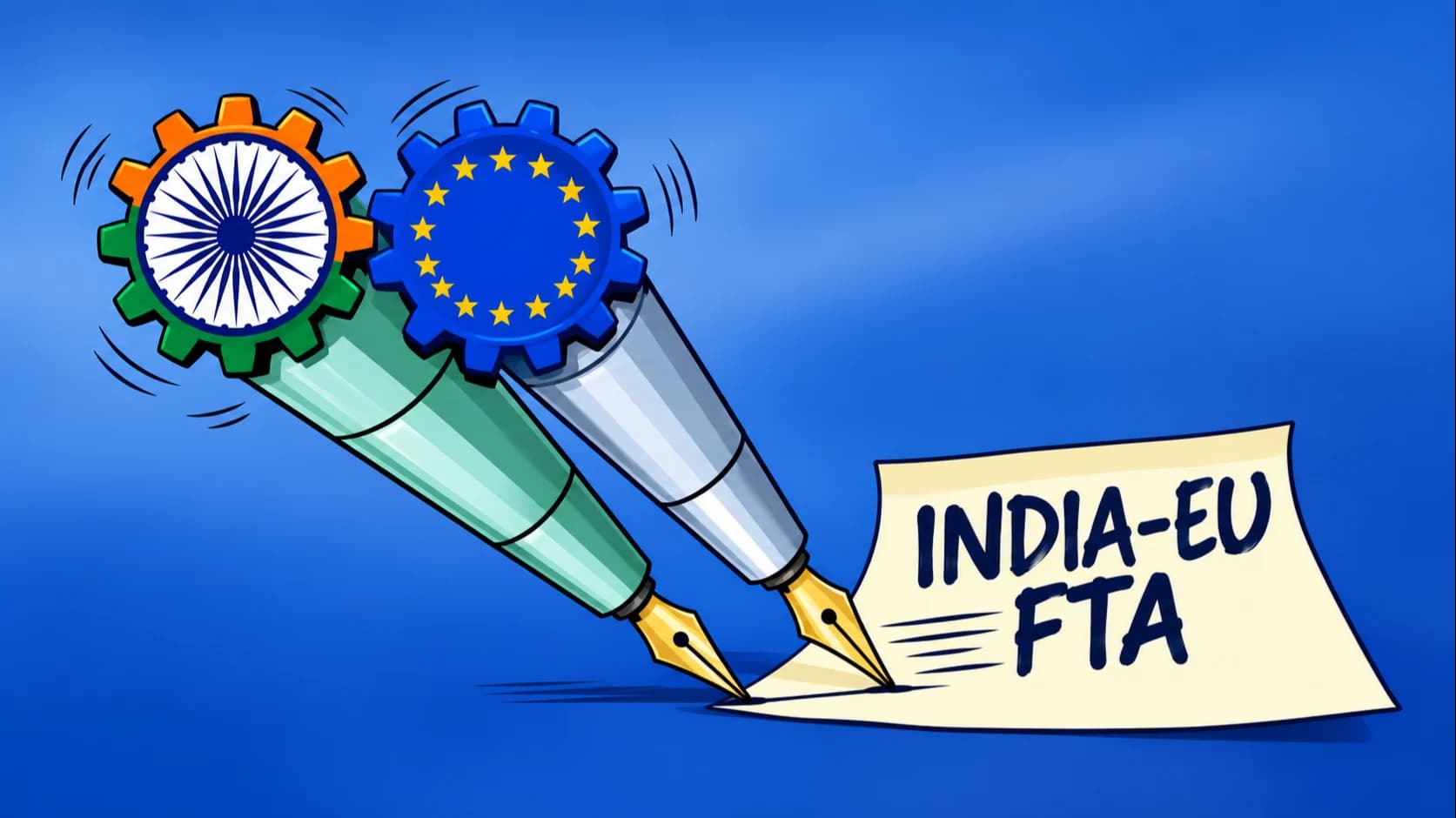
India and the European Union (EU) have concluded negotiations for a comprehensive Free Trade Agreement (FTA), the largest such deal ever concluded by either side. It will strengthen economic and political ties between the world's second and fourth largest economies, at a time of rising geopolitical tensions and global economic challenges, highlighting their joint commitment to economic openness and rules-based trade.
The agreement came together over nearly two decades of intermittent negotiations and during a geoeconomic crisis triggered by President Trump's trade war. The deal covers about 2 billion people and represents a combined market of nearly $27 trillion and about 25 percent of the global gross domestic product (GDP), and is expected to significantly reduce tariffs for India and the EU.
Background
The EU and India had first launched negotiations for a free trade agreement in 2007. The talks were suspended in 2013 and then relaunched in 2022. The 14th and last formal negotiating round took place in October 2025, followed by intersessional discussions at technical and political level.
At the same time as FTA negotiations were relaunched, the EU and India also launched negotiations for a Geographical Indications Agreement and an Investment Protection Agreement. Negotiations for these agreements are still ongoing.
What's in the deal?
The deal is India's largest and most comprehensive trade agreement and covers goods, services and investments across the EU's customs union. It will give India an edge in several sectors, including textiles, pharmaceuticals, machinery, steel, petroleum products and electrical equipment. Overall, the EU is giving India access to 144 services subsectors while India is opening 102 subsectors to the EU, including in the financial, maritime and telecommunications industries.
EU commitments
· Comprehensive Market Access: India has gained preferential access to the European markets across 97% of tariff lines, covering 99.5% of trade value, in particular:
o 70.4% tariff lines covering 90.7% of India's exports will have immediate duty elimination for important labour-intensive sectors such as textiles, leather and footwear, tea, coffee, spices, sports goods, toys, gems and jewellery and certain marine products, amongst others;
o 20.3% tariff lines covering 2.9% of India's exports will have zero duty access over 3 and 5 years for certain marine products, processed food items, arms and ammunition, amongst others;
o 6.1% tariff lines covering 6% of India's exports will have preferential access by way of tariff reduction for certain poultry products, preserved vegetables, bakery products amongst others or through TRQs for cars, steel, certain shrimps/ prawns products, amongst others.
· Labour-Intensive Sector Advantage: The EU has granted immediate zero-duty access for India's labor-intensive exports including textiles, apparel, leather, footwear, gems and jewellery.
o These sectors are poised to benefit from tariff liberalization and enhanced competitiveness, enabling deeper integration into global and European value chains and simultaneously creating job opportunities.
· Services Market Liberalization: The services dimension may prove transformative, too. The EU committed to opening 144 subsectors — particularly IT, professional services and education — and facilitate easier labour mobility.
· Farm Exports: The FTA provides India preferential access to the EU market for key agricultural and processed food exports, improving their competitiveness. This is expected to boost farmer incomes, promote value-added agri-exports, and strengthen rural and women-led livelihoods.
o India's Ministry of Commerce and Industry noting in a statement that India secured "preferential market access for its agricultural exports, boosting competitiveness for processed foods."
· Professional Mobility Framework: The FTA establishes a clear framework for temporary movement of professionals such as intra-corporate transferees, contractual service suppliers, and independent professionals along with provisions for dependents, students, and future social security arrangements.
· Regulatory and Standards Cooperation: Enhanced cooperation on Sanitary and Phytosanitary (SPS) and Technical Barriers to Trade (TBT) was agreed upon to reduce non-tariff barriers, enable conformity assessment recognition, and improve market predictability.
India's Commitments
· Calibrated Tariff Liberalization: India committed market access on 92.1% of its tariff lines, covering 97.5% of EU exports. Critical sectors including dairy, cereals, poultry, soymeal and select agricultural products remain protected, while automobiles, wines, and spirits are subject to gradual liberalization to shield MSMEs and farmers.
o For example, Indian tariffs on wines will be cut from 150% to 75% at entry into force and eventually to levels as low as 20%, tariffs on olive oil will go down from 45% to 0% over five years, while processed agricultural products such as bread and confectionary will see tariffs of up to 50% eliminated.
o Sensitive European agricultural sectors will be fully protected, as products such as beef, chicken meat, rice and sugar are excluded from liberalisation in the agreement.
· Services Sector Opening: India has opened 102 services subsectors, including telecom, financial, maritime, environmental, professional, and business services, providing EU firms a stable and predictable operating environment.
o The agreement provides a high level of protection and enforcement of Intellectual Property (IP) rights, including copyright, trademarks, designs, trade secrets and plant variety rights.
o It builds upon existing international IP treaties and brings Indian and EU intellectual property laws closer.
o This will make it easier for EU and Indian businesses that rely on IP to trade and invest in each other's markets.
· MSME-Friendly Rules of Origin: Product-specific rules of origin aligned with global value chains were adopted, allowing self-certification through Statements of Origin and special flexibilities for MSME-dominated sectors such as shrimps, prawns, and downstream aluminium products.
· Balanced IPR and Digital Trade Framework: India reaffirmed TRIPS-compliant intellectual property protection while safeguarding public interest, protecting the generic pharmaceutical industry, recognizing the Traditional Knowledge Digital Library, and balancing cross-border digital trade with data localization and digital sovereignty.
· Enhancing Sustainability Commitments: The agreement has a dedicated trade and sustainable development chapter, which enhances environmental protection and addresses climate change, protects workers' rights, supports women's empowerment, provides for a platform for dialogue and cooperation on trade related environmental and climate issues and ensures effective implementation.
o The EU and India will also sign a Memorandum of Understanding that intends to establish an EU-India platform for cooperation and support on climate action. The platform will be launched in the first half of 2026. Furthermore, subject to the EU's budgetary and financial rules and procedures, €500 million in EU support over the next two years is envisaged to help India's efforts to reduce greenhouse gas emissions and accelerate its long-term sustainable industrial transformation.
Current Status of India-EU Trade
The US remains the biggest overall trading partner for both India and the EU.
However, over the past decade, goods trade between India and the EU has grown substantially, rising from about $74bn in 2020 to $136bn in 2024-2025, making the EU India's largest goods trading partner.
India has a favourable trade surplus with the EU of more than $15bn as its exports of $75.85bn outpace imports of $60.68bn.
EU exports are heavy on machinery, transport equipment and chemicals while India mostly exports chemicals, base metals, mineral products and textiles.
The two sides hope to increase that to about $200bn by 2030.
From 2019 to 2024, India-EU trade in services also grew with Indian exports rising from $22.5bn to $44bn while EU exports increased from about $17bn to $34bn. The two mainly trade in business consulting and IT services.
India is the EU's ninth largest trading partner, accounting for 2.4 percent of its total trade, compared with 17.3 percent for the US and 14.6 percent for China.
As of 2024, 931,607 Indians resided in the EU, according to the Indian government. Comparative figures for EU citizens living in India are not available.
The EU says about 6,000 European companies operate in India while about 1,500 Indian companies have a presence in the EU.
Significance
· Geoeconomic Diversification: The FTA advances the China-plus-one strategy by positioning India as a trusted manufacturing and services alternative for the EU. In a global order where trade and technology are increasingly weaponised through sanctions and export controls, the agreement creates a rules-based “zone of trust” between two democratic blocs, especially for sensitive sectors such as semiconductors, AI, defence manufacturing, and green technologies.
· Increased Indian competitiveness: To access the EU market, Indian manufacturing will undergo a quality overhaul (Sanitary and Phytosanitary measures, technical standards). This "standards upgrade" (Brussels Effect) will make Indian goods globally competitive, not just in Europe but in US and Japanese markets as well.
· Strategic Leverage: The FTA connects India, the world's fourth-largest economy, with the EU, the second-largest, together representing 25% of global GDP and one-third of global trade. This creates a massive economic bloc, offering India strategic weight and deep integration with a leading technology superpower.
· Green and Digital Modernization Engine: The FTA focuses on digital trade rules and green transition, aiming to boost India's digital economy through secure data flows and AI-driven green industrial development.
Related Concerns
· EU's Regulatory Onslaught as Non-Tariff Barriers (NTBs): The EU's inclusion of environmental and labor standards in trade agreements raises concerns about green protectionism, where such norms may function not as neutral regulations but as de-facto non-trade barriers.
· Carbon Border Adjustment Mechanism (CBAM): This carbon tax directly impacts key Indian exports like steel, aluminium, and chemicals. From 2026, Indian steel exports could face a 20–35% tax equivalent, potentially wiping out gains from tariff elimination.
· EU Deforestation Regulation (EUDR): The EUDR bans imports of commodities like coffee, rubber, and wood produced on land deforested after 2020. Small Indian farmers must geotag plots and prove traceability, a compliance burden unaffordable for most smallholders.
· Corporate Sustainability Due Diligence (CSDDD): Effective from 2027, this directive forces companies to audit their value chains for human rights and environmental risks. Indian manufacturers are concerned about sharing sensitive supplier data, viewing it as a business risk.
· Industrial Accelerator Act: This proposed act may introduce local content norms (minimum domestic value addition). This would put pressure on imports, including from India.
Implications for Pakistan
For Pakistan, the deal raises important questions.
Erosion of Competitive Edge: The EU is Pakistan's largest export market, absorbing more than 27% of its exports, or about $8.8 billion in fiscal year 2025. Pakistan currently enjoys duty-free access on over 85% of its exports under the GSP Plus scheme, which is secured until at least December 2027 and is now under consideration for renewal. The deal would erode Pakistan's competitive edge in European markets.
Textile Sector Threat: Pakistan's exports to Europe are, however, highly concentrated. Around 70% consists of knitted and woven garments and home textiles such as shirts, jeans, bed linen, and towels. In these products, Pakistan currently benefits from a preference margin of around 5-9%. If the EU grants India similar or better access under an FTA, this margin could narrow, intensifying competition.
Analysts predict a potential 30% boost for Indian exports in key sectors like textiles, auto parts and agriculture, threatening to erode Pakistan's hard-earned market share in its largest export destination.
Basmati GI: There is also discussion around Basmati rice. Some fear that an EU-India agreement or changes to GSP Plus could hurt Pakistan's rice exports. In practice, Pakistan's main Basmati varieties already enter the EU at zero duty under the WTO commitments, and this is unlikely to change as a result of an EU-India deal. The more relevant concern relates to geographical indications. If India secures exclusive recognition for Basmati limited to its own varieties, Pakistan could face marketing and labelling challenges in Europe. This is primarily a legal and diplomatic issue, not a tariff one, and it requires active engagement.
What next for Pakistan?
The positive side is that Pakistan is now better placed to rethink its strategy. Gradual tariff reductions have lowered adjustment costs and made reciprocal agreements more feasible. This creates space to deepen existing agreements and pursue new ones with large markets such as the EU and the UK.
There is no immediate crisis. An EU-India agreement will still take time to enter into force, and tariff reductions will be phased in over several years. This provides Pakistan with some breathing room. That time should be used to improve export competitiveness by addressing practical constraints such as high energy costs, taxation, and access to finance. In the near term, safeguarding GSP Plus remains important.
At the same time, Pakistan should prepare seriously for a comprehensive trade agreement with the EU rather than relying on preferences alone. The global trading system is reorganising around deeper partnerships and clearer rules. As others move ahead, standing still is not a safe option. Pakistan must choose between shaping its place in the emerging trade landscape or adjusting to decisions made by others.
Conclusion
The India-EU trade deal is, indeed, a significant development. Agreed in principle and now moving toward ratification, the pact will eventually link the world's most populous country to a market of around 500 million consumers. For global trade flows, that scale alone is transformative. For Pakistan, whose export base is narrow and fragile, the implications are immediate and strategic. However, on a positive note, the deal has dismantled Pakistan's comfort zone – but not its opportunity. The competition will be won on the grounds of sustainability, speed, specialisation and smart policy. By leveraging its GSP+ compliance foundation to become an ESG leader, optimising for agility over sheer volume, diversifying products and markets, and decisively lowering domestic production costs, Pakistan can not only protect but grow its share in the EU. The threat is real, but so is the pathway, if Pakistan's industry wakes up, innovates and executes with unified urgency.
The writer is an academic.