

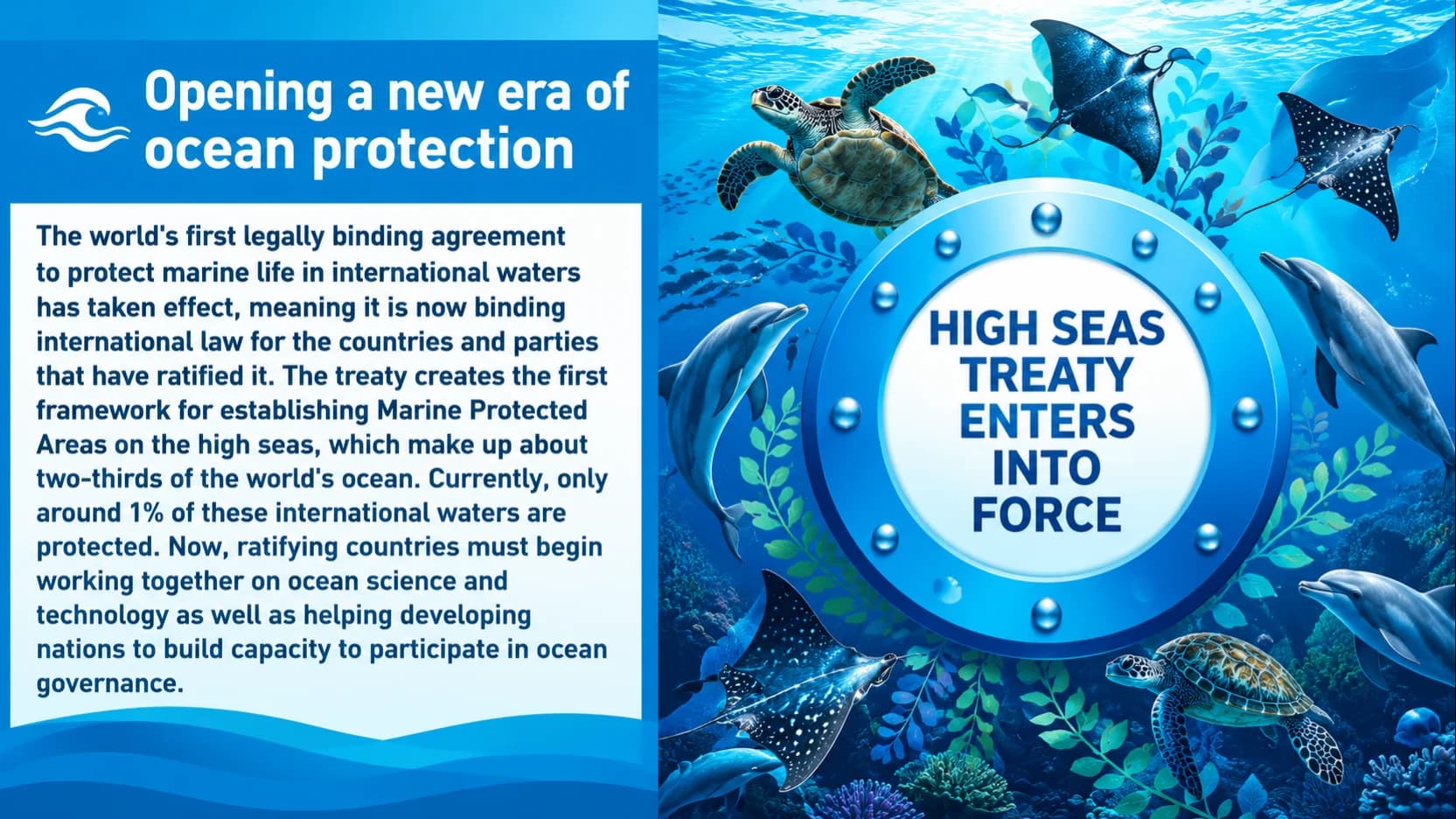
A landmark global treaty to safeguard biodiversity in the high seas came into effect on Jan. 17, 2026, providing countries with a legally binding framework to tackle threats such as overfishing and meet a target to protect 30 percent of the ocean environment by 2030.
The Treaty, which is officially known as the Agreement on the Conservation and Sustainable Use of Marine Biological Diversity of Areas beyond National Jurisdiction (BBNJ), came into force 120 days after the required threshold of 60 countries ratified the treaty – a target achieved on September 19, 2025. From illegal fishing and environmental degradation to human trafficking and unregulated resource extraction, the high seas have long been a lawless frontier. But with this treaty now in force, countries have a framework to establish marine protected areas, conduct environmental impact assessments and collaborate on enforcement and conservation.
What's the Treaty?
The BBNJ Treaty is a landmark global accord to protect marine life in the high seas and the deep seabed (the areas of the ocean that lie beyond any country's national jurisdiction).
o Adopted in June 2023 after nearly two decades of negotiations, the treaty applies to over two-thirds of the world's ocean.
It provides a legal framework to conserve marine biodiversity, promote sustainable use of ocean resources and ensure fair sharing of benefits from marine genetic materials found in deep-sea species.
Four Pillars
The treaty is built around four key pillars:
1. Marine genetic resources
The treaty will establish rules for sharing financial and non-financial benefits from the commercial application of genetic material sourced from high-seas marine organisms, such as bacteria, corals or deep-sea sponges.
o This material can be used in medicine, cosmetics, food and biotechnology; innovations with huge potential benefits for human health and wellbeing.
2. Area-based management tools
The treaty will create a mechanism to establish area-based management tools, including marine protected areas (MPAs), on the high seas.
o MPAs are typically clearly defined geographical spaces that are recognized, dedicated and managed, through legal or other effective means, to conserve marine biodiversity and ecosystem integrity.
o Some MPAs already exist on the high seas. For example, six MPAs were established in the Northeast Atlantic in 2010 with a total area of 286,200 square kilometers (110,502 square miles). The Ross Sea MPA was established in 2016 to protect a total area of 1.5 million square kilometers (600,000 square miles) in the Southern Ocean.
The treaty will also establish a pathway for proposing new zones for protection via a consultation process, supported by scientific evidence.
3. Environmental impact assessments
The treaty will create a standard process for these actors to conduct assessments that can be shared transparently and follow international standards.
4. Capacity building and transfer of marine technology
The Treaty also supports technology and knowledge sharing — particularly to low-income countries that need these resources to advance conservation and sustainable ocean management and ensure they can participate fully in high-seas governance.
What are the High Seas?
The term ‘high seas’ refers to ocean areas beyond national jurisdiction, i.e. beyond 200 nautical miles (Exclusive Economic Zones – EEZs).
They cover nearly two-thirds of the global ocean and about half of the Earth's surface.
The high seas form the international waters.
They belong to no one and are the responsibility of everyone!
The high seas take up half of the world's surface and account for 65% of the surface area of the oceans and 90% of their volume.
Note: In the high seas, a distinction is made between the water column and the seabed, called the Zone, which includes the seabed and substratum. The resources in the Zone are considered the common heritage of mankind. The International Seabed Authority (ISA) regulates exploration and mining while maintaining environmental protection.
Why the Treaty matters?
The ambition of the Treaty has always been immense. It seeks to facilitate international coordination on activities within Earth's largest public common, covering around half the planet's surface.
a. Sustains life
The high seas are not remote, empty waters; they are full of life. They host a diverse array of marine life, from microscopic plankton to colossal blue whales.
Alongside supporting global fisheries and food security, they are home to valuable natural resources that countries and companies are ever more eager to explore and exploit.
o For example, marine genetic materials are increasingly sought after to support pharmaceuticals, biotechnology and other innovations.
b. Global Protection Framework
Before the Treaty, protecting biodiversity in international waters was extremely limited.
o They have been governed patchwork style through regional fisheries agreements, shipping conventions and scattered marine protected areas which cover less than 1% of the high seas.
The Treaty now provides a legal pathway to turn conservation ambition into action.
o It will fill regulatory gaps, complement national efforts and enable coordinated conservation measures on the high seas, all of which will be critical for achieving international climate and biodiversity goals.
It will also help guide regional cooperation and link seamlessly to countries' sustainable ocean plans, through which 21 nations have pledged to sustainably manage 100% of the ocean areas under their jurisdiction.
Together, these measures will come together to create a more cohesive system of ocean stewardship spanning from coastlines to open ocean.
c. Helps achieve SDGs
The Treaty is essential to achieving the global target to protect 30 percent of the ocean by 2030, often known as 30×30.
Marine Protected Areas in international waters are a central part of this goal.
They help rebuild biodiversity, strengthen ecosystem resilience and support sustainable fisheries and coastal communities.
Protecting the high seas brings the 30×30 goal much closer to being achieved.
At the same time, it strengthens the ocean's role as our greatest ally in the fight against climate change, helping stabilize systems that communities everywhere depend on.
d. Shows the vitality of cooperation
The Treaty is a powerful example of what is possible when nations and people work together.
o By making protection possible in international waters, the Treaty turns global biodiversity commitments into achievable outcomes.
It reflects years of perseverance and dialogue, showing that even in complex and challenging times, the world can still unite around a shared responsibility for something that belongs to us all.
For multilateralism, as much as for the ocean, this moment matters.
Who has (and hasn't) signed up?
The countries that have so far ratified the BBNJ include several major economies, notably China, Germany, Japan, France and Brazil. China has a particularly important impact on industries connected to the ocean (such as shipbuilding, aquaculture, fisheries and offshore oil and gas), exporting some $155 billion of ocean-related goods in 2023, according to UN trade agency figures.
The US, the world's biggest economy, is one of the top five ranked ocean-related goods exporters ($61 billion). Although the country signed the treaty in 2023, it is not yet ratified, and the Senate has not acted on it.
India, one of the top developing-economy exporters ($19 billion), adopted the treaty in 2024 but domestic legislation on ratification is still pending. While the UK did introduce legislation on the matter in 2025, parliament is still to ratify it.
Russia remains one of the minority of nations that has neither adopted nor ratified the treaty, citing its wish to preserve existing governance frameworks, and ensure that freedom of navigation and shipping in international waters is guaranteed.
What's Next?
The Treaty’s coming into force is only the first step toward its implementation. The focus now turns to building the Treaty's institutions, decision-making processes and ways of working.
Ratifying countries will now have to begin working together on ocean science and technology, and must also help developing nations build capacity to participate in ocean governance.
Companies planning activities that could harm marine life must conduct environmental impact assessments that meet the Treaty's standards.
Those conducting research on ocean organisms that could be used commercially, such as for new medicines, must notify other countries and share their findings.
Perhaps most significantly, countries must now promote the Treaty's conservation goals when they participate in other international bodies that regulate ocean activities, such as regional fisheries organizations, the International Maritime Organization and the International Seabed Authority.
Conclusion
The highly anticipated entry into force of the High Seas Treaty is indeed a celebration for biodiversity and multilateralism, as it marks a “historic milestone” for global ocean conservation. Now international law, the Treaty will empower nations to establish a connected network of marine protected areas, which can be adopted by a vote when consensus cannot be reached. This helps prevent a single nation from blocking MPAs being established. Now that the treaty is in effect, the difficult task of establishing marine protected zones begins. Countries must work together to create proposals for protected zones with unique rules and regulations. The work ahead will require leadership, collaboration, and sustained investment. But entry into force is a long-awaited step forward — offering real hope for the future of our ocean.
The writer is an expert on International Law,
and a CSS mentor.
